
Mayer and Miyagishima Honored With ASC President's Award
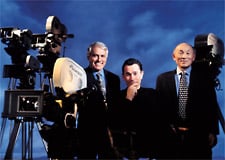 |
| Albert Mayer, Sr. and Tak Miyagishima, recipients of the 1998 ASC Presidents Award, flank Panavision CEO John Farrand. |
Veteran Panavision employees Albert Mayer, Sr. and Tak Miyagishima have received the 1998 Presidents Award from the American Society of Cinematographers. Miyagishima is the firm's senior vice-president of engineering, and Mayer is senior vice-president of research and development. The presentations were made at the ASC's 13th annual Outstanding Achievement Awards gala, held at the Century Plaza Hotel in Century City on February 21.
"Albert and Tak are among the many unsung heroes who work behind the scenes in our industry," said outgoing ASC President Woody Omens. "They have made historically significant contributions by helping to provide the tools we need to explore the full potential of our art. They deserve this recognition, both for their achievements and for their relentless dedication to progress over a sustained period of time."
The ASC Presidents Award is presented to individuals who have made exceptional contributions to advancing the art of filmmaking. Miyagishima and Mayer have joined an elite club that also includes such former honorees as visual effects pioneers Linwood Dunn, ASC and Hans F. Koenekamp, ASC, film preservationist Kemp Niver, ASC, cinematographer Bill Clothier, ASC, visual effects maven Douglas Trumbull and actor Robert Duvall.
Miyagishima joined Panavision in 1955 as a draftsman, only a few months after Robert Gottschalk founded the company. Mayer was hired as an engineer in 1968. Originally, Panavision manufactured and sold lenses to exhibitors, enabling them to project movies in the CinemaScope format. Subsequently, the company segued into designing and manufacturing lenses for motion-picture cameras. According to Miyagishima, by 1958 the growing popularity of television had taken a big bite out of the movie audience. To lure fans back to the cinemas, the studios began producing epic widescreen movies. Twentieth Century Fox held a patent on the CinemaScope format, and was charging other studios licensing fees. Then Panavision developed a series of Auto Panatar lenses designed for producing movies in the widescreen anamorphic format. These instruments quickly became standard for widescreen movies at all of the major studios except Fox, which remained committed to CinemaScope.
"Our lenses had a counter-rotating element which could be adjusted for close-ups," says Miyagishima. "That was an important feature, because actors and actresses tended to look as if they had fat faces in CinemaScope close-ups. In 1965, [director] Mark Robson prevailed upon Fox to allow Bill Daniels, ASC to use the Auto Panatar lenses on Von Ryan's Express. That was a great day at Panavision."
Before joining Panavision, Mayer worked briefly for the Mitchell Camera Company. "The Mitchell BNC cameras were the standard in the industry for 40 to 50 years, but many cinematographers felt they were too cumbersome for location work," he says. "They also wanted reflex viewing. I think management at Mitchell had come to feel that the industry had to listen to them — Bob Gottschalk was listening to the industry." The Panavision PSR camera, introduced in 1968, was a highly modified version of the Mitchell BNC camera. Some six years later, the company produced its first Panaflex camera.
Continues Mayer, "All of us learned from Bob Gottschalk. Sometimes he came running in here like the devil was chasing him. Usually, Bob had just been visiting a cinematographer and had come up with an idea [for a new process]. The next thing you knew, we were working on a device to help camera operators compose images in dim light, or something to help an assistant cameraman. He never said, 'This is good enough.'"
Miyagishima reflects upon the time that the late Freddie Young, BSC asked Panavision to develop a special long focal-length lens. Young initially utilized the lens to film the famous mirage scene in Lawrence of Arabia (see "Best Shot Films: 1950-1997" on page 130). In another instance, director Robert Wise requested that a special lens be designed so that he could create an eerie type of optical distortion for The Haunting. Notes Mayer, "We have many stories we could tell about cinematographers and directors who challenged us to find solutions to the technical problems they needed to solve. That's the secret — Bob Gottschalk was right. As long as there are dreamers who challenge us to do better, the possibilities for the future are unlimited."
| [ Go to the top ] | © 1999 ASC |