If the box-office smash of the Star Wars Special Editions proves anything, it's that audiences are hungry again for what purists once disparagingly referred to as "space opera." However, French director Luc Besson's audacious new film, The Fifth Element, owes less to George Lucas than to the absurdist sensibilities of Jean-Luc Godard. Likewise, the film's intense imagery was dreamed up in part by French artists Jean "Moébius" Giraud (of the Gallic graphic magazine Metal Hurlant) and Jean-Claude Mézières (Valerio — Agent of Time and Space), who, along with production designer Dan Weil, helped Besson visualize a fantasy film which the director had nurtured for nearly 20 years. Along the way, the filmmaker refined and expanded his ideas to include every effects innovation of the past two decades.
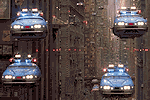
The result is a visually stunning, living comic book that plays out across a fully realized galaxy — from a New York stretching 600 stories in every direction (complete with traffic jams caused by flying cars) to a luxurious outer- space pleasure ship cruising over a water planet. The Fifth Element's far-reaching vision of the future demanded a virtual "sampler" of visual effects, and Besson chose Digital Domain to achieve it all.
Approximately 85 model-makers and 85 artists worked on finishing the film's 220-plus effects shots at any one time. Leading the pack was first-time visual effects supervisor Mark Stetson. A former modelmaker (Blade Runner, The Hudsucker Proxy), Stetson closed his shop, Stetson Visual Services, just after completing a colossal miniature of the ill-fated Exxon Valdez for Waterworld. Within four months, he joined Digital Domain on The Fifth Element.
Assessing the duo's on-set relationship, visual effects producer Dan Lombardo (The Island of Dr. Moreau) notes, "Luc is the type of director who is very hands-on with every aspect of a production. On this show, he didn't delegate a whole lot, except when it came to something he didn't know very well. That's when he'd lean over to Mark and ask him to step in."
Stetson himself affirms, "It was great to have that kind of relationship with Luc, who is normally extremely private and protective. The movie's design was heavily influenced by the look of Seventies' French comic books, which made it really fun to work on. Although part of it takes place in a futuristic New York City, I think the setting is quite different from the Los Angeles of Blade Runner. The flying cars are a lot more whimsical, and the city is set in broad daylight. The film is rooted in a much more utopian vision of the future than Blade Runner, which virtually defined the post-apocalyptic look of futuristic films for more than a decade."
The Fifth Element opens in early 20th-century Egypt as a spaceship — piloted by a saintly race of aliens called the Mondo-shawan — descends toward Earth. A pleasing, rusty red hybrid of a conch shell and a football, the alien craft was designed by Metal Hurlant artist Moébius, and was constructed as an 8' miniature by Digital Domain's model shop; a digital matte painting derived from NASA photographs doubled for Earth.
Upon arriving, the oval Mondoshawan craft hovers on energy beams above a bizarre rock temple. The production crew painted a doorway on a gigantic rock rising from a dry lake bed, transforming it into the temple exterior. Most of the plates were shot by Luc Besson and The Fifth Element cinematographer Thierry Arbogast, AFC, with Digital Domain's visual effects director of photography, Bill Neil, acting as an advisor.
After a decade working as a camera assistant and camera operator, Neil began his effects career at the then-fledgling Industrial Light & Magic as an equipment designer and camera assistant on The Empire Strikes Back and then became a camera operator on Return of the Jedi. Neil subsequently went to work at Boss Film, where he first met Mark Stetson in 1983, before joining Digital Domain a decade later.
Neil had worked with demanding directors in the past, but Besson insisted that all of his creative options be left open — a caveat which could have spelled trouble for visual effects work. "We shot a number of alternate background plates — different angles — and it was only in the editing phase that we saw what was going to work," Neil recalled during a recent phone conversation from London, where he was about to begin work as visual effects supervisor on the upcoming James Bond film Tomorrow Never Dies. "I didn't have a camera crew, so Luc and Thierry photographed all the plates, and I helped them technically with post issues."
Besson had a very symmetrical, center-weighted cinematographic style in mind for The Fifth Element. While the director had shot his previous films in 2.35:1 anamorphic, The Fifth Element would be shot in Super 35, partly to accommodate the intense visual effects demands. This decision meant that the production didn't have to shoot VistaVision background plates or use duplicate camera packages. The main unit used Arriflex cameras, and Stetson, Neil and company reluctantly agreed to use the Arris for their effects work. "We were skeptical," Neil admits. "We tried to push toward Panavision because we felt we had a better chance of having a steady plate camera, but the Arris were pretty good. The production was using the Arri 535B, and most of our plates were shot with a production camera. We also used a prototype of the new 435 high-speed camera. About halfway through production, Arriflex replaced our prototype with one of their first production 435 cameras. I was amazed at the performance of this camera in terms of its steadiness at all speeds. In fact, it was rock steady, good enough for matte work from two frames to 150 frames a second — in both forward and reverse. I've never seen any camera made anyplace in the world that could do that."
While the Arris proved their worth, the effects team was concerned about stories of cameramen who refused to shoot Kodak's European-finished stocks because of steadiness issues, and convinced the production to import Rochester-finished emulsions for anything that was to involve visual effects, as well as the surrounding footage. Ultimately, Arbogast used Kodak 5293 for non-effects sequences, and shot the picture's considerable amount of green-screen work on the slower 5248 stock. While most effects plate interiors were shot on 5293, Neil shot some plates of the "vertical hunk of rock" that served as the temple on 5245 at "quasi-magic hour."
Though the Mauritania plates were filmed prior to a formal design of the effects shots, Stetson says that the series yielded "a nice sequence of six spaceship shots." The 8' Mondoshawan spaceship miniature was shot by Neil's visual effects co-cinematographer, Paul Gentry, who matched the model lighting to the plate's rosy sunset look as the Mondo-shawan visit the temple and then lift off again.
[ continued on page 2 ]