The American Society of Cinematographers salutes 1997's finest television artistry.
With each passing year, television's top directors of photography continue to close the gap between projects shot for television and those tailored for the big screen. Increased improvements in film emulsions, better telecine transferring capabilities and these artists' fierce devotion to their work have raised the benchmark of standard "TV fare" to a pinnacle that sometimes rivals the look of even the highest-budgeted features.
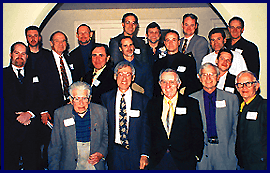
Many of the form's finest practitioners were feted at the American Society of Cinematographer's 12th Annual Outstanding Achievement Awards celebration, held on March 8 at the Century Plaza hotel in Los Angeles. The audience included 1,400 of their industry associates, as well as many fellow directors of photography. Each of the 13 nominees for Best Cinematography in the television medium exhibited passion and artistry with their respective works, as well as a commitment to visual excellence.
ALAN CASO - Winner
George Wallace
First-time ASC Award nominee and recipient Alan Caso began his career by establishing himself as one of the industry's top Steadicam operators on such productions as Romancing the Stone, The Hunt For Red October and The Arrival. As a director of photography, Caso has compiled credits in both television (Black Out, Summer of Fear, Tonya and Nancy and 20 episodes of the series Raven) and on features (Ed, The Stepfather III, In the Midnight Hour and Top of the World).
George Wallace, which chronicles the tumultuous life of the controversial Alabama governor, reunited the cinematographer with director John Frankenheimer. Caso had previously worked with Frankenheimer as an operator on the feature 52 Pickup, and had admired the director's integrity and sensitivity to characters, as well his attention to the authenticity of a film's setting.
Spanning 20 years, the miniseries depicts Wallace's life via a combination of archival footage - gathered from multiple sources in multiple formats - and the filmmakers' re-creation of Alabama's racial struggles during the 1950s, '60s and '70s. Critical to the integration of the newsreel material - which was either 16mm or Kinescope footage - was the creation of a look that was both effective in telling Wallace's life story over the course of several eras and compatible with the archival footage of the real Wallace. Early on, the filmmakers decided to shoot Wallace in both color and black-and-white for select sequences. For the color footage, Caso elected to use Eastman Kodak EXR 5298, pushing the stock two stops while overexposing by 2/3 of a stop to effectively degrade the imagery and simulate the look of the archival footage. The black-and-white segments were rendered on Double-X 5222, which was also pushed to degrade the quality of the images to that of a "film that has been on a shelf for 15 years."
After extensive testing, Caso decided to utilize bleach-bypass processing on the internegative to further desaturate colors and heighten the contrast. However, this technique also affected the black-and-white footage, which sometimes had to be flashed upwards of 30 percent during initial capture to bring the contrast down.
Both Caso and director Frankenheimer had specific ideas about the use of camera movement in Wallace. The cinematographer often utilized a jib arm on a dolly as his main A-camera platform - freeing the camera from a more fixed, tied-down perspective - and also made heavy use of a Steadicam, which was operated by David Crone. Caso used an Arriflex 535B for most of the A-camera material, and a Moviecam Compact for the Steadicam work. He employed Zeiss lenses for their contrast, sharpness and slightly cooler quality.
Frankenheimer also wanted to hold very deep focus, and staged action in several layers to add depth to the frame. The filmmakers used mostly wide-angle lenses ranging in length from 18mm to 28mm; close-ups were generally shot with a 35mm or 50mm lens. Caso often lit sequences at a stop of between T5.6 to a T8.5 to obtain enough depth to hold focus from 18 inches to deep in the backgrounds. The director of photography also notes that Frankenheimer wanted the piece to be moody, but sought to avoid a typical "period" look, opting instead for a visual style that was strong and effective but not overly "self-conscious."
DAVID FRANCO
Intensity
"There are shorter production schedules in the realm of television, but I'm rarely the one who suffers the most because of it," submits David Franco, who earned his third ASC Award nomination with the mini-series Intensity. "I think it's the director who suffers. In the end, a lighting setup takes about the same amount of time. Since I've been doing television films, I've never really had to compromise what I've wanted to do. Actually, I think you have much more freedom now in television than in the past, when some people weren't able to do what they wanted to."
Franco was nominated for an ASC Award in 1994 for the mini-series Million Dollar Babies (see AC May '95) and then in 1995 for the MOW Falling for You (AC May '96). His other television credits include Free Money, The Assignment, Silent Trigger, Trial by Vengeance, Soul Survivor, The Carpenter, Model By Day and Hollow Point.
Intensity was the first time Franco worked with director Yves Simoneau, but the cinematographer was familiar with his work. "Yves is from Quebec, and I had lived in Quebec for a while, so we knew of each other beforehand. When he got the project, he called me up and we ended up shooting the film together in Vancouver. Yves is a very visual and has strong ideas about how a film should be shot. I generally prefer working with directors who have strong visual ideas than those who give you a completely open frame in which to work. Having a strong director visually only means that you can take things higher than if you start from ground zero."
Over half of Intensity takes place inside a recreational vehicle "during the pre-dawn twilight, right before the sun comes up but when you still have light in the sky," explains Franco. "Since we were shooting in Vancouver in the fall, almost every day was cloudy and overcast, so we were able play things as 'magic hour' shots almost all day long. I shot on tungsten-balanced film without any correction and underexposed quite a bit. There was a lot happening in the RV itself, so we had another RV in the studio that we cut into; we did a lot of poor-man's process, because shooting in rainy Vancouver was a bit taxing on the schedule.
"I take a very naturalistic approach when it comes to lighting, so I tend to play the light through the windows," he adds. "When we had a few night sequences, I actually played the night much warmer than the day, because all of the daytime 'magic-hour' shots were very blue. I therefore made the night scenes much more yellow and orange, simulating the look of real sodium-vapor streetlights."
The remaining third of the film takes place in a basement where a serial killer has sequestered his victim. "The basement had this long corridor with a very low ceilings," Franco recalls. "Yves has a strong preference for wide-angle lenses, so we were using wide-angle lenses in the basement and showing the ceiling to make the space feel much more enclosed. Even though the wide angles may make the room seem bigger, you're seeing all four walls and the ceiling around you, so you really feel the environment. We would even shoot our close-ups with a 24mm or an 18mm, very close to the actors, which can become quite a trick. When you have a dolly move in on an actor, he has to have three or four different eyelines all the way through the move or he'll start to appear as if he's looking away from the lens as the camera moves in. When you set an eyeline with a piece of tape on the inside of the matte box and then move it even a fraction of an inch, it can look as if he's looking four meters away."
KEES VAN OOSTRUM, ASC
Medusa's Child
Born in Holland, cinematographer Kees Van Oostrum, ASC earned his third ASC Award nomination with Medusa's Child. His first nomination came in 1992 for the miniseries Burden of Proof (see AC May 1993); he then won in 1993 for Return to Lonesome Dove, Part II, which was also nominated for an Emmy Award (AC May/Oct. '94). Van Oostrum received an Emmy in 1990 for the ABC special The Last Chance, as well as a nomination in 1992 for Miss Rose White (AC Oct. '92). His other credits include the miniseries Son of the Morning Star, Day One and An Inconvenient Woman, the MOWs Down Came A Blackbird, The Enemy Within, Children of the Dark, and The Long Road Home, as well as the pilots for Profiler and Second Noah. He has also shot the feature films Thinner (AC April '96), Blue Heaven, A Certain Fury, Separate Lives and Gettysburg.
Van Oostrum is also the inventor of the Panther Aerocrane, an ergonomically-balanced telescoping jib arm constructed from aluminum.
Medusa's Child was directed by Larry Shaw and concerns an embittered scientist who sends his ex-wife to deliver a package to the Pentagon. While aboard the cargo plane, the package is discovered to be a nuclear bomb. Since the majority of the film takes place within the tight confines of the aircraft, one of Van Oostrum's primary concerns was to sell the effect of being aboard an actual moving plane flying through bad weather although the footage was actually shot within the comfortable confines of a soundstage. To create the illusion, the filmmakers built an 80' mockup of the cargo plane interior on a gimbal to create the requisite movement, often utilizing cranes and snorkel lenses to further enhance the photographic approach.
With so much of the material taking place inside the cargo plane, using a greenscreen outside the windows proved unfeasible, so a black Duvateen backdrop was hung outside the set. Rain bars and wind machines helped to create the sense of movement. Additionally, Van Oostrum also had a self-supporting lighting system that helped simulate turbulence during scenes in which the plane was battered by the elements. Against this frenetic backdrop, the story then becomes a race against time as the FBI and the crew aboard the cargo plane try to defuse the bomb.
[ continued on page 2 ]