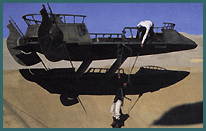
The American unit had to prepare the Arizona and northern California locations for the beginning of the U.S. filming which would begin after 59 days of shooting in England.
All the exteriors of Jedi were shot on locations in California and Arizona and a massive American crew was being assembled to take over production when the interiors were finished. The combined construction department of the two main locations already numbered more than 100 people. With the arrival of the key personnel from England, production would begin at the desert location outside Yuma, Arizona.
If you don't control the film in preproduction, it will control you when you shoot it. Bearing this in mind, and armed with a detailed set of storyboards, I scoured the redwood Forest for locations. It was raining, but I was—promised sun for the shoot months ahead.
A misty deep forest look was selected for the Ewok sequence and we found some spectacular areas. In the deep ravines and valleys of the northern coastal range there's not much light on the forest floor by the time it filters down through the high canopy of redwoods, especially if it's foggy or misty, which it often is. There was just not enough light for 5247, so I shot tests with 5293. Because of the added image generations needed for their work, ILM was concerned with the 93 image quality when shot at a higher ASA than 250. So, I tested the 93 at 250,400 and 500 ASA with the 85 filter. The tests were sent to ILM and then to England for Alan Hume and Director Richard Marquand to analyze. For ILM the best results were at 250 ASA with the 85 filter, so in fact we rated the 93 at 400 ASA normal and shot all the low light forest scenes at this rating.
Many of our forest locations were on coastal ridge tops which get quite sunny during May, so we had a possible problem in having to maintain the subdued forest look with all that bright sun. The average weather pattern for that area for May/June was morning mist/low clouds, clearing by mid-day with possible clouds in the afternoon. I had already been instructed by a grinning George Lucas that "We will not wait for light." Taking him at his word, I accepted his challenge. I did not intend to see four or five hundred people standing around waiting for the light to change. So, we had to find an approach to get the required look with the predicted light conditions. I suggested that we design the forest shooting schedule so that in the morning, with its predicted mist and fog, we could shoot the high ridge locations and the other areas with sparse tree cover. Then during the brightest time of the day we would shoot the lower canyons, where the sun would be broken by the thick forest canopy.
My contacts at the Lucas Production Department—Jim Bloom, Bob Brown, Lata Ryan and Miki Herman—considered the idea and quickly agreed. I remember being impressed with their speed and efficiency.
As it turned out, this decision and its accompanying formula for scheduling allowed us to shoot almost constantly - we were never delayed by light because we were always in the right spot for the time of day. Occasionally we had to wrestle with a stray beam of sunlight, but basically we were "always ready." And the forest film has a wonderful consistent look.
With all the locations spread over several square miles of redwood hills we decided to go with HIM lights for ease of movement—with proper grounds in case of rain. The main locations would be pre-cabled before we arrived.
In older redwood trees the top limbs, when dead, will fall onto other branches and hang there like gnarled telephone poles 100 feet up the three—sometimes for years until the right wind conditons occur. then, they fall, silently at first, until they crash through to the ground. They're called "widow makers" by loggers, and every older forest is filled with them. Lucasfilm put on a full time logging crew to remove all the widow makers in the areas where we worked. Even with that precaution, whenever the wind came, we all looked up into the trees.
The forest location would be the 2nd on the schedule of the two major sets, the first being Jabba's Barge in the desert. This decision was based on weather until the rains finished in May the forest access roads would be impassable.
Back in Los Angeles I assembled our basic camera crew. The operators were Tom Laughridge and Mike Menson. Camera Assistants were Leo Napalitano, Bob Labone, Steve Tate, and Mike Glennon. Alan Hume would bring his two assistant cameramen, Michael Frift and Simon Hume, with him from England, along with Camera Grip Chunky Huse.
We could prep some of the equipment here but some had to wait to be released from the shoot in England. Lucasfilm had been testing anamorphic lenses for some time and had determined that the British made Dunton Lens was the best for their purpose. At that time there were only 3 sets of these lenses in existence - prototypes. Two were on our show, one half-set at Leonetti's Cine Rental in Los Angeles and the other half-set was at Dunton's Shop in London. Our camera package consisted of two Arri BL IIIs, one Arri III, and two Arri 2Cs.
Again armed with the incredibly detailed notebook of storyboards I set off for Jabba's Barge in the sand dunes outside Yuma.
Standing on the barge, five stories above the dunes, the wind whistling through the rigging, with gusts of sand blasting across the curved surfaces of the Sarlacc pit, I turned to the always available production personnel: "we will need a full time camera machinist here for the sand." Generally we would house the camera maintenance room at the hotel, but in this case, knowing we'd have a 40ft. trailer just for our cameras, I decided to put the trailer permanently under the Jabba set, which was built on telephone poles 30 ft. above the desert floor. We shrouded the space with plastic sheeting for wind and sand protection. Here, we could house a permanent maintenance and dark room facility. With the entire set above and on all sides we were also protected from the tremendous heat.
[ continued on page 2 ]