The principals and Richard Marquand would shuttle between San Rafael and our forest location. On one occasion we needed a close up of Harrison Ford reacting to the exploding bunker. Explosion effects are often simulated with arcs, but this time I asked Roy Arbogast to prepare a giant "flash pan" to be fired a safe distance from Harrison. We tested the effect and it needed more punch. Since I often use mirrors on exterior locations we pulled a 4X8 off the grip truck and positioned it right next to the explosion to reflect the light of the flash. So, for a split second the light from the flash pan blasted onto Harrison's face before the mirror was clouded by smoke.
A key factor in any major battle sequence is clear information distributed throughout all departments. And some of these departments were huge: 45 men in construction (some days over 100); Glen Randall used 18 stunt people; Roy Arbogast had 23 special effects technicians; Fern Bros. and the greens department numbered 31, costume 34 and security 24.
David Tomblin would have his morning production meeting dealing with the days work. There was never any confusion, never any rush. Most, if not all, of the effects were dangerous with explosions, smoke, trees falling, etc., but not one person was hurt. there was always a clear line of communication that went all the way to George Lucas.
Safety was always standard policy because we never rushed. there was always time to do it right and always the right amount of help to do it fast.
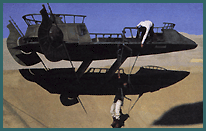
Leo Napolitano did an incredible shot sitting in a bosun's chair descending along 400 feet of cable through some large explosions and smoke and finally into a large pad.The shot needed running Ewoks and Storm Troopers. Every department had plenty of time for every job—because we were just across the forest shooting something. When they were ready they called us in. We set up all available cameras for extra cuts, rehearsed it twice, shot it twice, and printed both takes. It was terrific!
David Tomblin has a very good instinct for drama in action. He and stunt coordinator Glen Randall would come up with some great ideas integrated with the storyboards and always shot multiple camera for the best possible cuts.
The extra camera wouldn't just shoot a varied size of the master. We would set them off to the side or even in the rear and use the master angle effect/explosion, etc., as a background for another bit of added foreground action.
For weeks I'd been looking at this 50 foot skag—an old, rotted, burnt-over redwood tree, dead so long it was dangerously close to falling down. I suggested to David Tomblin that we blow it up. Naturally there was nothing in the storyboards about a giant skag falling over, but he liked the idea. I went to Richard Edlund to see what ILM thought about it. He said shoot it and if it was exciting enough he'd put in a scooter or a Chicken Walker in the picture somewhere. But first we'd need Production Department O.K., which meant George. By the next day we had approval and a rough set of boards to cover it. Roy Arbogast allotted his crew to it and a few days later we shot it. This was definitely not the company for slow decision makers.
As I look back on this project, I remember looking up at the 30-foot Chicken Walker and seeing an ILM Operator and ILM Assistant standing on top doing a hand-held shot with one of our Arri IICs and having a great time. It to me represents the real combining of visual effects with live action shooting.
There are now many new techniques and systems available for production shooting. We've reached a time when films can be made up of computer generated images and optical transformations only. But because of the very different mechanics involved in each system—live action, optical, computer—there's a tendency to keep them separate. Of course, combining new techniques immediately has the potential for confusion. But this experience has convinced me that we can't think "separate system".
On the two earlier Star Wars pictures ILM had always worked as separate unit with separate storyboards and shooting schedule, etc. On Jedi we started out separately, but because of the cooperation of Richard Edlund we took advantage of our close proximity and common working goal, and we began a blending process that was complete by the end of the picture.
The result of this was more coverage, more exciting visuals and a better use of all available techniques. For, after all, we did have a common goal: putting some wonderful imagination on a 60 foot screen. And that's what I like to do best.