
Sponsored by:

Illuminating Show and Discussions Last November, downtown Phoenix, Arizona, played host to Lighting Dimensions International '98, a trade show for lighting professionals. The convention floor offered hundreds of animated intelligent lights, fiber-optic systems, and fixtures for all architectural, theatrical and motion-picture applications.
Prior to the three-day convention, LDI '98 was host to a week-long collection of intensive workshop meetings on a multitude of subjects, from AutoCAD design to the basics of power distribution. Dubbed "LDInstitute," these events were great opportunities to spend time with select experts in each field.
Here are some highlights of both the workshops and equipment that this reporter found to be of particular interest.
by Jay Holben
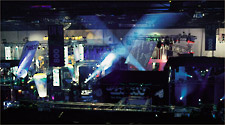
A view of the show floor at LDI '98, held at the Civic Convention Center located in downtown Phoenix, Arizona.
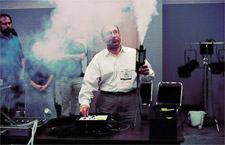 |
| Rosco's Eric Tishman demonstrates a glycol-based fog cannon manufactured to be completely self-sufficient for permanent installations in theme-park environments. |
"The Black Magic of Ultraviolet," a day-long session held on the stage of Phoenix's Civic Center Ballroom, was led by moderator Jeffrey Hillinger from @utomated Entertainment. The workshop focused on the ins and outs of working with different ultraviolet emitters. One of the principal sources demonstrated was Hillinger's vacuum-thin, film-coated dichroic filters. When used in connection with high ultraviolet-emitting sources, such as HMI and Xenon lamps, these filters transmit harmless, long-wavelength UV radiation from 340 to 380 nanometers (with a peak at 365), while blocking all short-wave radiation below 315 nanometers. With dichroic filters, nearly 100 percent of the UVa necessary for fluorescent pigments to retro-reflect is transmitted, as opposed to less than 61 percent with a standard absorbing filter.
Utilizing this process, @utomated Entertainment offers rentals on extremely efficient "black light" fixtures ranging from 200W to 18K. "Most commonly," explains Rolf Bender, a European Industrial Designer who has spent the last 25 years working with UVa-reactive plastics, "fluorescence refers to the property of emitting visible light during radiation by ultraviolet. The visible light given off can be of almost any color, depending on the substance which is fluorescing, and, to a lesser extent, on the wavelength of the ultraviolet light which causes the fluorescence. In order for a substance to fluoresce under ultraviolet light, some impurity must be present. The amount of impurity is also critical; if there is too much, the fluorescence will either be diminished or completely eliminated."
Many different substrates and pigments have been found to have fluorescent properties in a multitude of colors. For best results, these materials are illuminated by a peak of 365 nanometers — the "magic" frequency.
Throughout the seminar, Hillinger and Mike Friedman of Nocturn Ultraviolet Visual Effects demonstrated a multitude of materials: plastic, fabric and even "kitchen supplies" such as laundry detergent which, because of the added fabric-brightening chemicals, have fluorescent properties.
Of the materials presented, by far the most visually dynamic were the 'invisible' black-light paints. These pigments, when illuminated under ultraviolet light, display entirely different colors than they do under normal, full-spectrum light. Utilizing these pigments, it is possible to turn a painted backdrop from a daylight scene to a full nighttime scene simply by removing the normal lighting and illuminating the drop with ultraviolet light.
When photographing black-light effects, Hilliger explains, "you are not working with reflected light, but rather retro-reflected light that comes from exciting fluorescent elements in the material." When you hit a fluorescent material with UV light, the elements are excited to a retro-reflective state and will emit visible light and color. The ratio of incident ultraviolet light to retro-reflected light from a fluorescent source will depend on the materials used and the colors within them.
@utomated Entertainment, (800) 880-6567, website: http://home.earthlink.net/~automated_hd.
Nocturn Ultraviolet Visual Effects, (818) 255-0620, website: www.nocturnuv.com.
Rolf Bender (49) 0-228-971-1970, website:www.depro-bender.de
Improving Luminance Measurement
Karl G. Ruling, technical standards manager of the Entertainment Services and Technology Association, was joined by Larry Lieberman, the chairperson for ESTA's Photometrics Work Group, and seven-time Emmy Award-winning cinematographer Bill Klages to demonstrate a new photometrics "nutrition chart" that ESTA is proposing as a standard for the industry. The Photometrics Work Group, the fourth largest in terms of voting membership in ESTA's Technical Standards Program, is working to develop "E1.9" Entertainment Lighting Luminaries — Presentation of Photometric Performance Data. The standard defines the minimum data to be presented on documents describing the photometric performance of a fixture.
One of the problems in current photometric-data presentation, as explained by Ruling, is that the data is collected from an imaginary spherical surface; readings are taken in three-dimensional space in a circular pattern. Realistically, when a technician reviews the "real–world" performance of a fixture, "they shine it at a wall," comments Ruling. "Comparing the readings taken off a flat surface to the photometric data recorded from an imaginary sphere will result in confusing and frustrating findings."
With the new ESTA system, side-by-side comparisons can be made on a level playing field. The standard begins by supplementing the common "V" chart, which shows footcandle levels over various distances from the luminaire, with a graphic representation of the source projected on a flat surface. Imposing this representation over a fixed grid, a series of isolux lines for various luminance values can be plotted on a common graph, and the output performance of a fixed fixture can be quickly evaluated.
In addition, the standard lists a "nutritional chart" of information, including total lumen output, cutoff angle, tenth-peak angle, half-peak angle (these terms were adopted over the former "beam angle" and "field angle," respectively, which were more easily misinterpreted), efficiency, and lumens per watt. The chart will also list the testing lab presenting the material, as well as a list of available globes for the fixture, with the tested performance data for each globe and a designation as to which one was used for the isolux graphic. Formulas will be provided to convert practically useless candela information (commonly provided with "throw multipliers" from the isolux graphic) into workable footcandle readings. The sample data sheet is available for public evaluation and comment via the ESTA website.
ESTA, 212-244-1505, website: www.esta.org.
| [ Previous page ] |
| [ Next page ] |
© 1999 ASC