Uninhibited Camera for A Streetcar Named Desire
Harry Stradling establishes a new high in cinematic artistry with his imaginative camera treatment of A Streetcar Named Desire.
This article originally appeared in American Cinematographer's October 1951 issue. For full access to our archive, which includes more than 105 years of essential motion-picture production coverage, become a subscriber today.
A Streetcar Named Desire, winner of the Pulitzer Prize and the coveted New York Drama Critics Award, scored as one of the most powerful dramas in modern theatrical history when it electrified Broadway a few seasons ago. It was impossible to imagine at that time that this play could ever be translated into the language of the screen with its basic power undissipated. But Warner Brothers have accomplished the impossible by bringing the vehicle to the screen with its original honesty and force intact. If anything, the film is even more compelling than the play, because the camera has added a scope and fluidity that could not be achieved within the confines of the proscenium.
Streetcar is a rare blending of superbly executed cinematic elements: screenplay by its original author, Tennessee Williams; acting by Vivian Leigh, Marlon Brando, and supporting members of the Broadway cast; direction by Elia Kazan; and photography by Harry Stradling, ASC. These elements, each of which is a triumph in its individual right, add up to a filmic drama with Academy Award possibilities. There is such perfect rapport between elements that it is impossible to tell where the effect of one leaves off and the other begins.
In his superlatively executed camera treatment, director of photography Stradling has struck exactly the right note in a vehicle which made extraordinary demands upon the science of cinematography. His photographic approach called for a blending of pungent reality and vague fantasy, spirituality and animal passion, beauty and shabbiness, frustration, loneliness and violence. This pot pourri of paradoxical human emotions has been stirred by a master hand to emerge as a photographic tour de force.
The camera treatment and lighting style evolved from the dramatic demands of the story. The locale of Streetcar, an important motivating force of the plot structure, is a street called Elysian Fields in the Old Quarter of New Orleans. Here, Blanche DuBois, (Vivian Leigh) a pathetic dreamer of dreams, wanders one day. Her world of magic, created as a buffer against sordid truth, is destroyed by two men—her brother-in-law, who hates her on sight, and his friend, who fails her when she needs understanding and devotion most. Defenseless, Blanche goes tragically to her ruin, as her sister and sympathic neighbors look on, unable to help.
This savage expose of raw emotion is strong stuff—and there will undoubtedly be those who will consider this film (like Ace in the Hole) sordid, depressing and too nakedly real. To capture the emotional violence of the plot on celluloid, Stradling arrived at a photographic style that is at least as honest as every other phase of this remarkable production. His task was to create the atmosphere of a steaming, dirty, evil-smelling fragment of what was once the most lavish quarter of a fabulous city. Elysian Fields lingers shabbily in the shadow of its ghostly former elegance. Its inhabitants are a crew of primitively passionate beings— and the atmosphere of the setting is very much a part of their violent behavior.
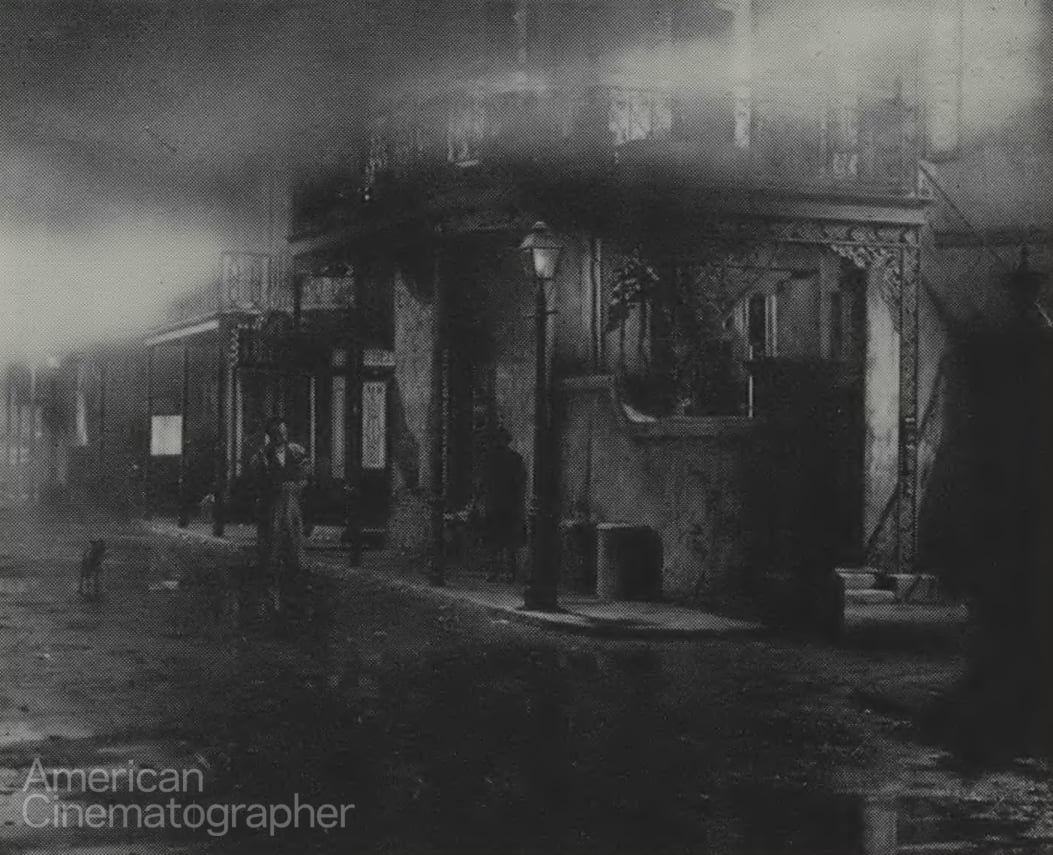
The effect of this locale on the screen is a perfect combination of settings by five-time Academy Award winner Richard Day, and the photography of Stradling. The exterior street scene, constructed inside Stage One of the Warner Brothers’ lot, is lighted for low-key night effect to provide a mood of sordidness softened by the romance of fantasy as visualized through the dream-shrouded eves of the main character. Added to the effect of the lighting is a fine mist, so subtle and yet so compelling that one can actually feel the oppressive humidity of New Orleans.
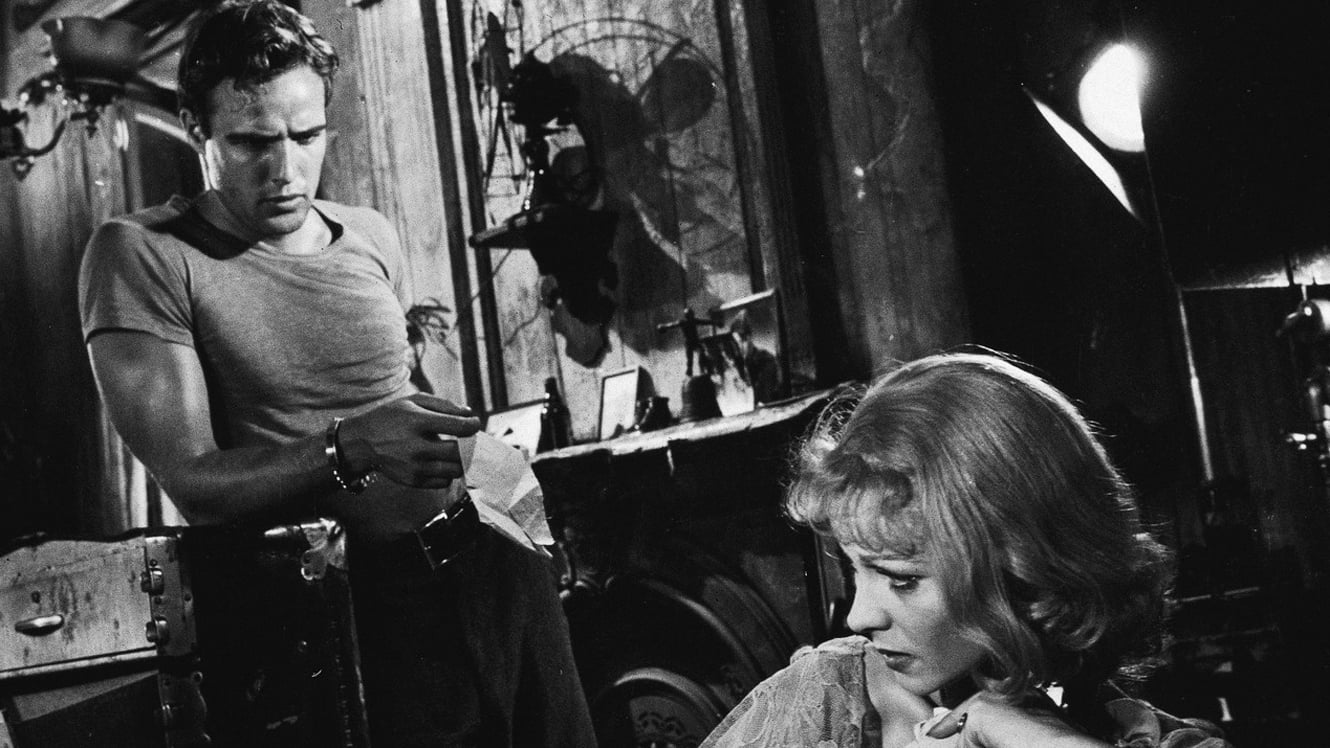
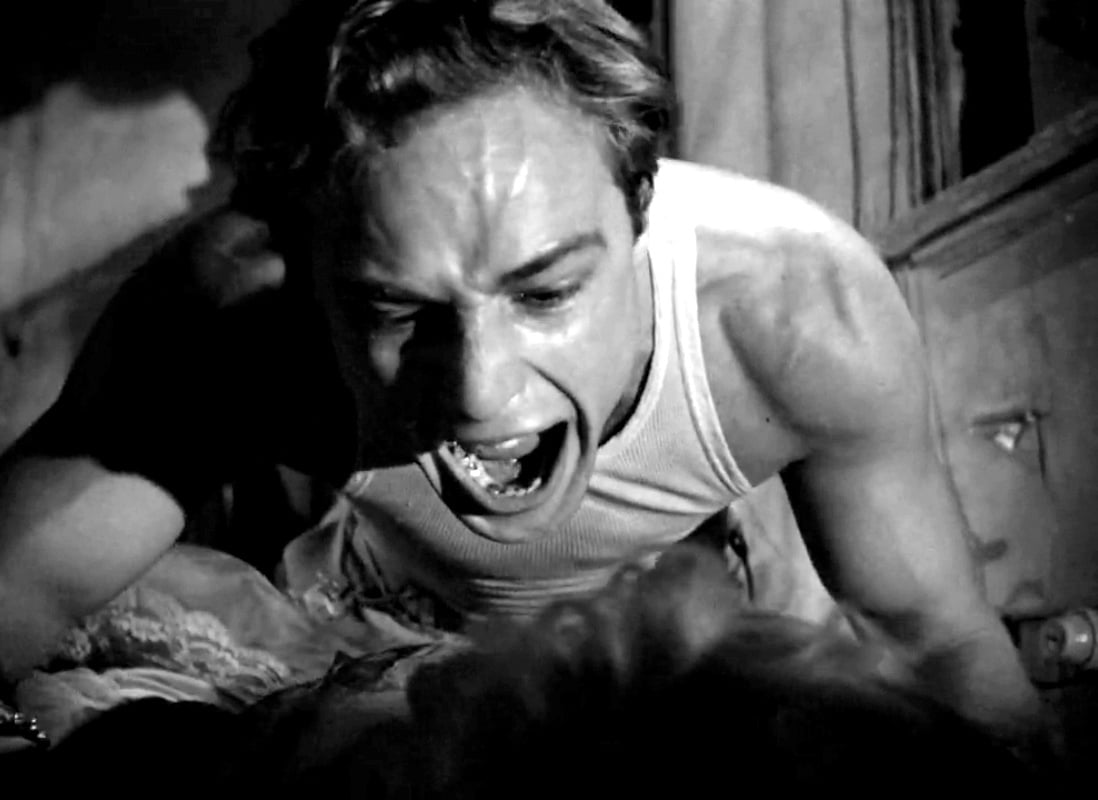
The night effect of this street is in striking contrast to the day scenes which transform the Quarter into a teeming, raucous mélange of sound and color. Photographically, this contrast in lighting key adds powerful shading to the dramatics of the story. The main action, however, takes place within a shabby, crowded apartment to which clings only the faintest trace of a bygone elegance. Within this confined space is played the main action of the film, and it was a great challenge to light this confined space as a suitably modulated background for the great range of emotion projected against it. Stradling achieved this result through an honest style of low-key that chucked glamor out the window and dragged in reality by the hair of the head.
Stradling is enthusiastic in his praise of director Elia Kazan, maintaining that the film’s photographic honesty is due in great measure to the fact that he was encouraged by this fine director to kick over the cinematic traces. “'Gadge’ Kazan kept telling us all to be bold, until finally ‘be bold!’ came to be a kind of battle cry on the set. It was wonderful to be able to light a picture without having to worry about the fact that the star’s face would be in shadow during part of the scene. When a light burned out, we’d often leave it out, because the effect was more honest and dramatic that way.”
The artistic integrity of the star, Vivian Leigh. A very lovely person in real life, Miss Leigh kept coming up to ask him if she were wearing enough make-up to make her look old and haggard for the meter is deep enough to measure to the center of an 11x14 plate or film...yet convenient for production control of both 16mm and 35mm motion picture processing. Filters furnished to read the Yellow, Magenta and Cyan densities. role. She was quite willing to use more, if necessary. After years of having to use every trick in the book to make actresses look their glamourous best, Stradling found Miss Leigh’s attitude most refreshing.
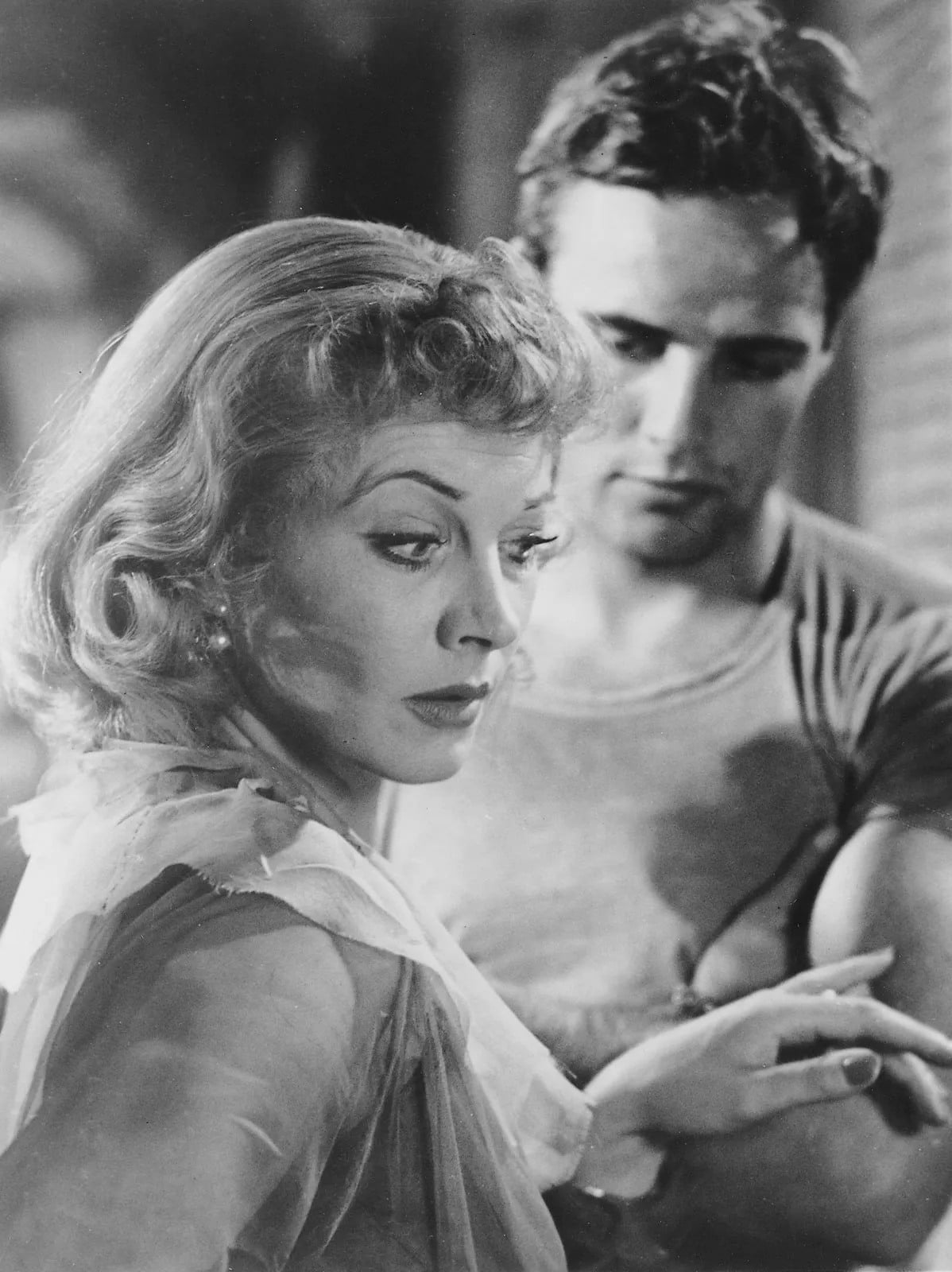
One of the most interesting lighting effects in the film is used in the sequence in which Miss Leigh, portraying the hallucinations of approaching madness, dresses in a crumpled white satin evening gown complete with rhinestone tiara, and dances about the room in the belief Linear density scale .0 to 1 covering full scale length with additional push-button ranges of 1 to 2, 2 to 3 and 3 to 4. Reads Color and Black & White densities—defused visual and print densities. The final answer to processing control. that she is an elegant Southern belle who has just received an invitation for a cruise in the Mediterranean. The room is supposedly illuminated only by small, subtly shaded lamps. In the romantic lighting thus produced, she looks ethereal, with a fragile loveliness that ties in perfectly with her fancied image of herself.
At this moment, the antagonist enters the room and switches on the main light. Instantly the illusion is shattered. The evening gown looks cheap and gaudy; the rhinestone tiara looks like dime-store rubbish; the woman herself looks dissolute and worn—old with the compressed age of imminent madness. The two sharply contrasting styles of lighting used so closely together account for much of the impact of the sequence.
Another dramatic sequence, involving a knock-down-drag-out brawl between the drunken brother-in-law and his cardplaying buddies is filmed entirely with rim-light, creating an atmosphere of harsh brutality the likes of which have seldom been recorded on film. Here again, it is as much that which is left to the imagination, as that which is actually shown, that gives the sequence its hammer-like punch.
From the purely mechanical standpoint, photography of the picture within its main set presented certain problems. The set was necessarily a small one, since much of the dramatic impact of the plot arises from the basic situation of three volatile personalities confined in close quarters. The problem was to preserve the feeling of cramped space, while still allowing the camera mobility and a variety of angles.
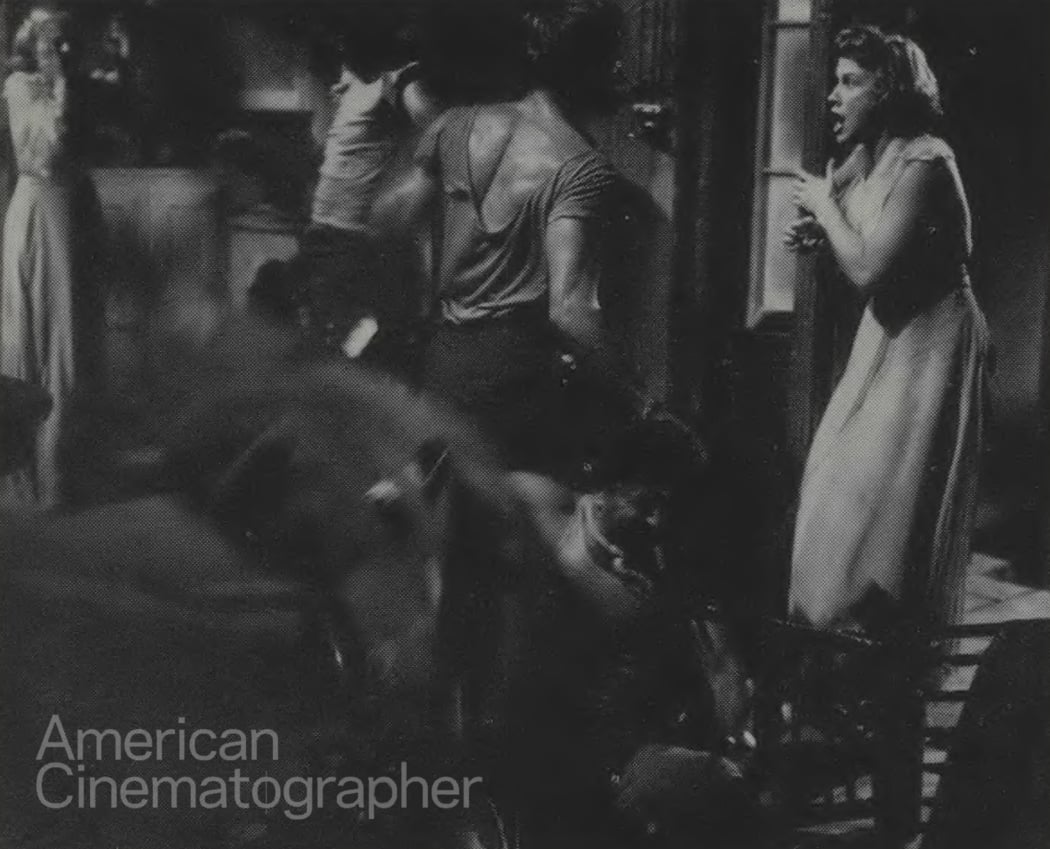
Removable or “wild” walls permitted camera set-ups from almost every angle, but even so it was the originality of the director of photography that accounted for the great variety of point of view from which the action was filmed. Even the shots made from directly overhead are well-motivated and add greatly to the dramatic effect.
Fluid camera (as thought of in terms of boom, dolly and tracking shots) was severely limited by the set plan, so instead the action was played up to and away from camera, creating an effect of fluid action in relation to the lens. The large number of striking close-ups in the film point up every flick of an eyelash for fullest effect.
Stradling’s compositions are extremely forceful, especially the split-focus shots characterized by a large head in the foreground and a full figure dominating the background. As every technician knows, such shots usually call for a wide-angle lens—but a wide-angle would have exaggerated the perspective of the rooms, making them look too large and destroying the closed-in effect. As a result, the entire production had to be shot (and the necessary compositional effects achieved) with 35mm, 40mm, 50mm, and 75mm lenses.
To film actual scenes of New Orleans (most of which unfortunately do not appear in the final cut), the cast and crew went on a four-day location jaunt to that fabled city. Working all night, they shot scenes at the L. and N. Station at the foot of Canal Street, while literally thousands of people looked on. Although the original streetcar named Desire has since been replaced by a bus named Desire in busy New Orleans, the city made it possible for the star to ride the trolley by importing one of the retired trams and putting it into active service once more, just for the film incident.
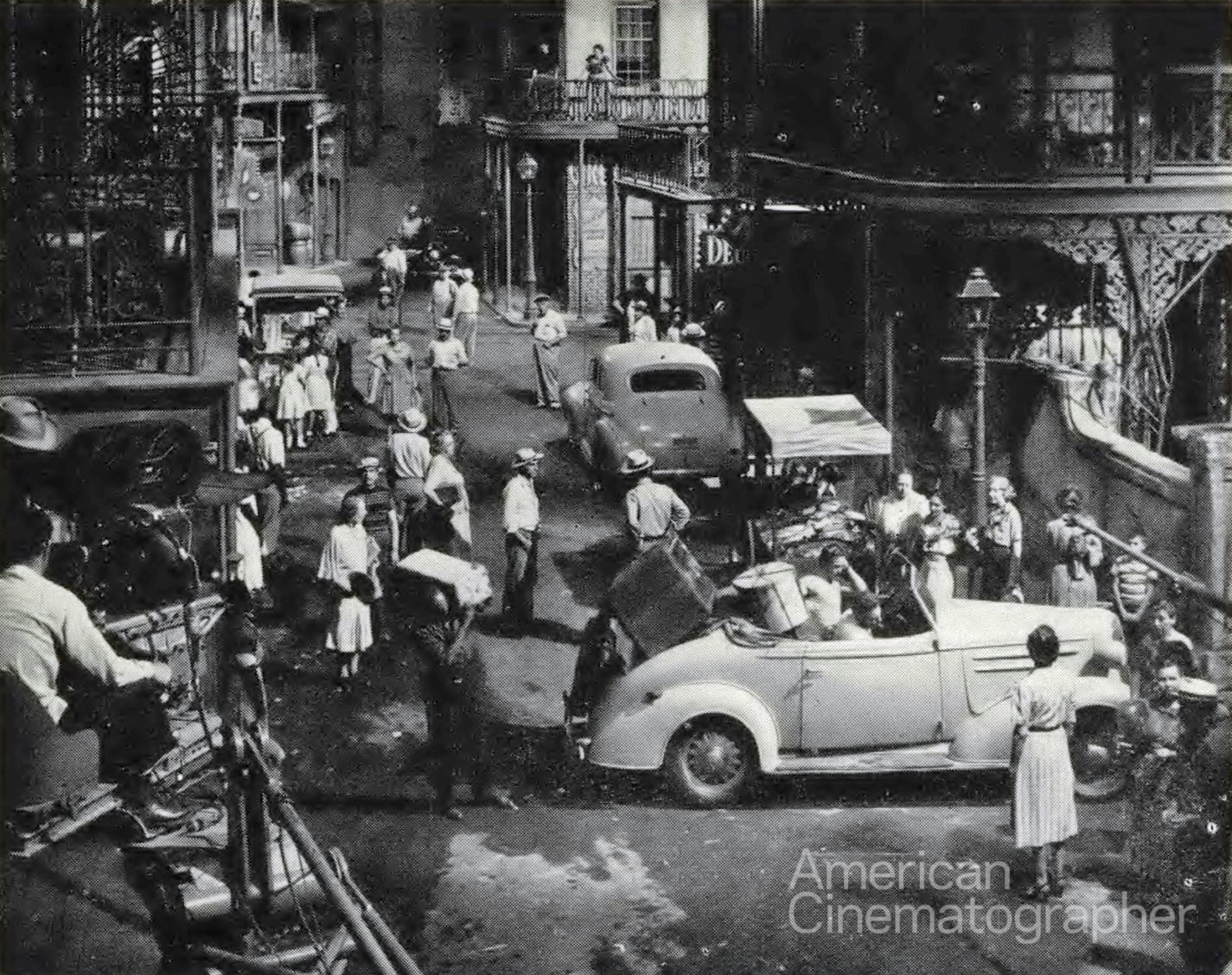
Commenting on the filming of the picture, Harry Stradling explains: “There are two facts that worked very much in my favor while shooting Streetcar. One is the complete free rein given me by the production heads."
"I was encouraged to plan and execute the photography exactly as I saw it in terms of the script. My camera was not inhibited by any cut-and-dried rules."
"The second advantage was the two days’ of rehearsal shooting we did prior to actual production. The shooting done in these two days was not meant to be used in the picture. It was set up solely as a method of experiment, to try out effects and set a definite style. As a result, the actual shooting went much faster, and we weren’t forced to do our experimenting while shooting for keeps.”
For Harry Stradling, A.S.C., Streetcar was an important milestone in a long and eventful career. When just 16 years old he began his career as an assistant to his uncle who was Mary Pickford’s first cameraman at the Famous Players-Lasky Studio in New York. After that, he worked in rapid sequence as assistant to ten or twelve other cameramen, including George Folsey and Ernie Haller. At the ripe old age of 19, he became a full-fledged director of photography, probably the youngest in the history of the industry. He worked on one of the first talkies in 1929, a film called Syncopation, starring Morton Downey. He then sailed for Paris supposedly to film one picture, and ended up staying in that magic city for six years.
Stradling was brought to Hollywood under contract to David O. Selznick, but his first picture was My Son, My Son, for Edward Small.
When his contract was completed, he signed with Samuel Goldwyn, and his first effort for that producer was Edge of Doom. On loan-out he shot Valentino for Edward Small and My Son John (unreleased) for Paramount. He recently completed I Want You for Goldwyn and is currently at work on Androcles and the Lion at R.K.O.
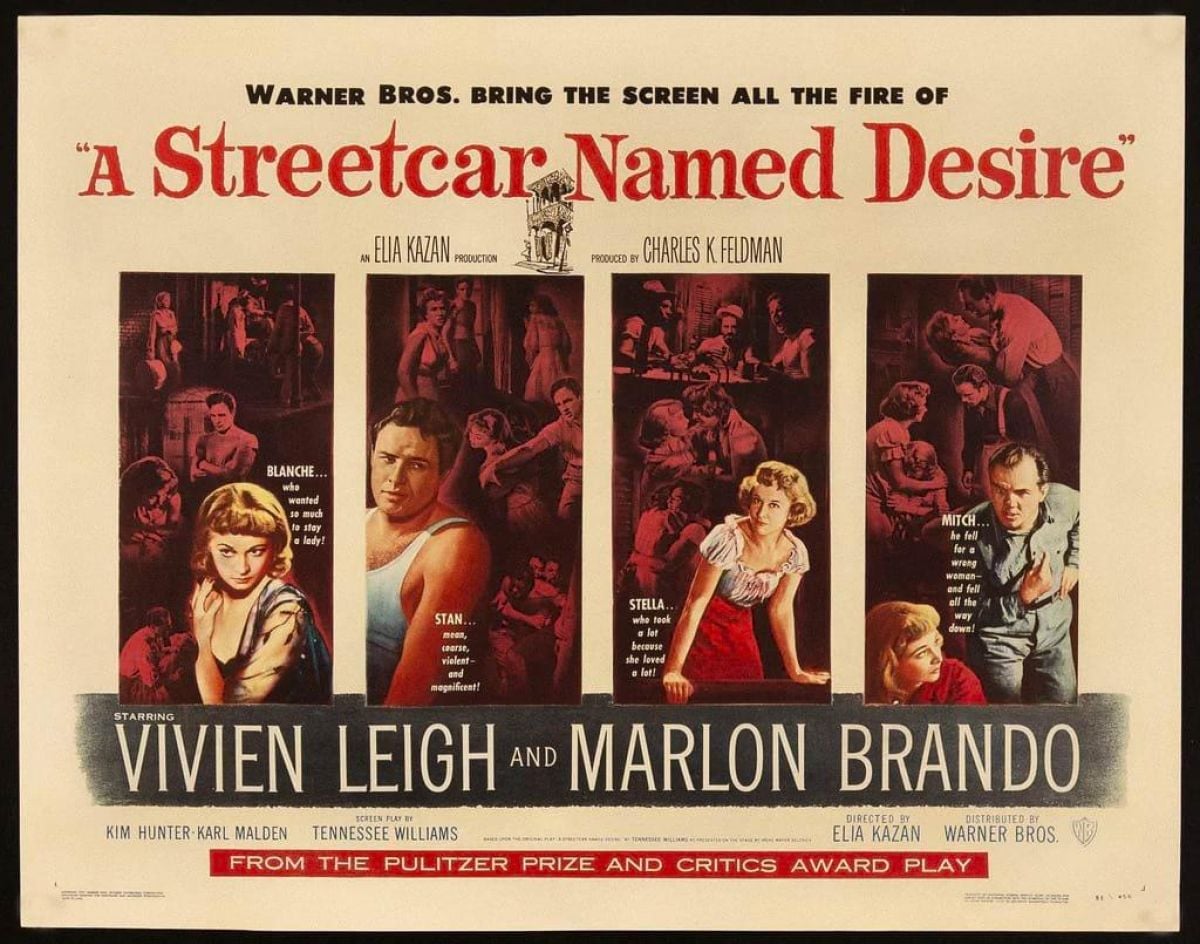
A Streetcar Names Desire grossed over $53 million on a budget or only $1.8M, and racked up 12 Oscar nomination, with wins for Best Actress in a Leading Role, Best Actress in a Supporting Role, Best Actor in a Supporting Role and Best Art Direction-Set Decoration, Black-and-White.
Harry Stradling went on to add several more classics to his resume following Streetcar, including Guys and Dolls, My Fair Lady, Funny Girl and Hello, Dolly!