Inner Demon: Guillermo del Toro's Hellboy
Guillermo Navarro, ASC surveys the challenges of Hellboy, the tale of an unlikely superhero who struggles against his own dark nature.
This in-depth look at the making of Hellboy first appeared in American Cinematographer's April 2004 issue. For full access to our archive, which includes more than 105 years of essential motion-picture production coverage, become a subscriber today
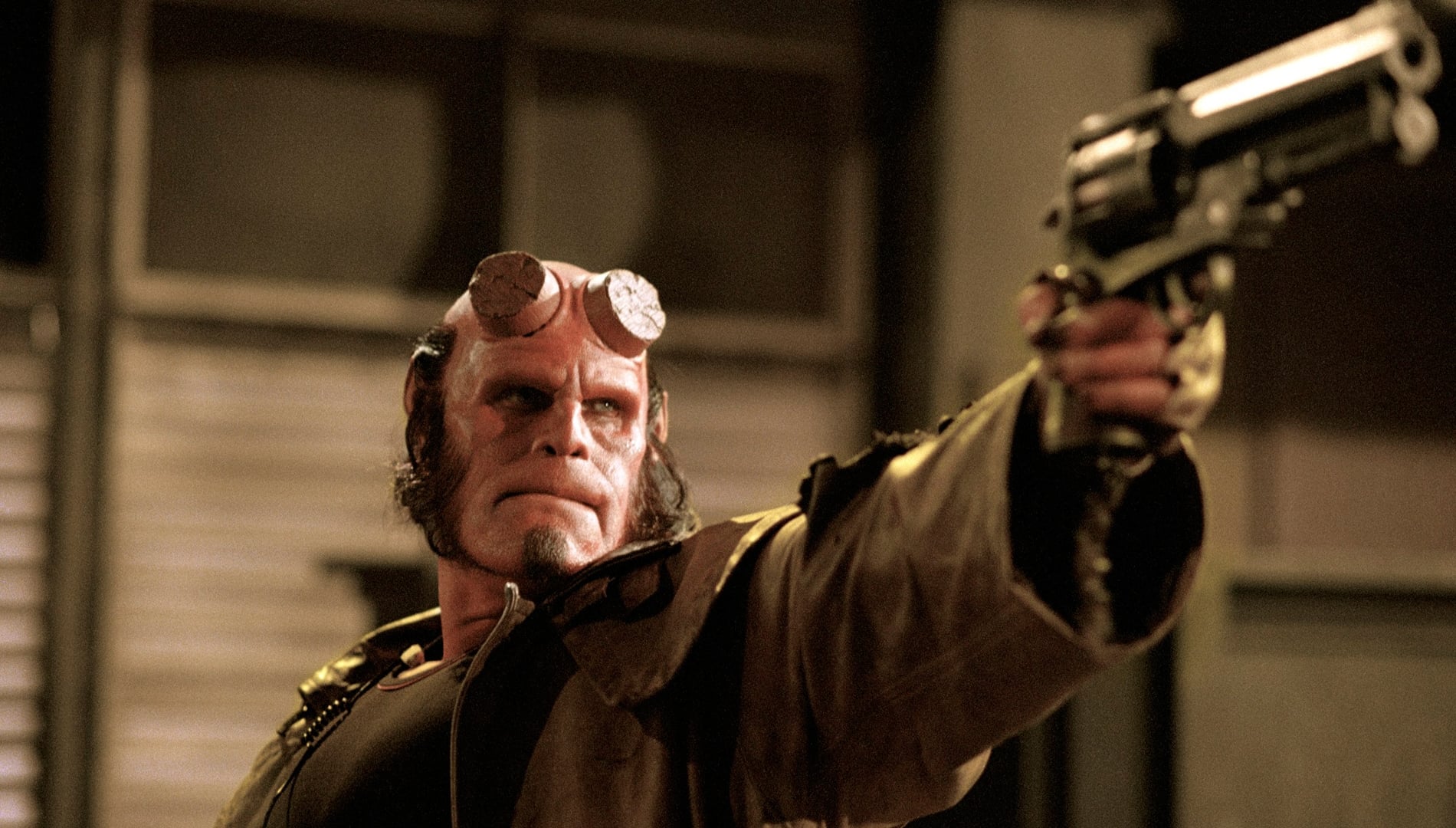
Over the course of his previous films, Mexican director Guillermo del Toro has become something of a specialist in all things subterranean. This is undoubtedly a good start for the director of a movie called Hellboy. Based on Mike Mignola’s popular comic-book series, the film tells the story of an unlikely superhero who is ripped at birth from the mouth of hell by Nazis and other unsavory characters (such as the mad monk Rasputin), but fortuitously falls into the hands of better-intentioned U.S. agents. Hellboy (played as an adult by Ron Perlman) may have horns, a tail and red skin, but he fights the good fight against various villains and monsters, while also battling the dark impulses brought on by his own demonic DNA. It’s an uphill struggle: as Hellboy’s protector and mentor, Prof. Broom (John Hurt), warns, “In the absence of light, darkness prevails.”
According to director of photography Guillermo Navarro, ASC — del Toro’s friend, countryman and collaborator — this line provided not only the movie’s theme, but also the key to its visual style. “There are very few daytime scenes, and even if it is day, it’s dark,” he attests. Hellboy and his unorthodox colleagues, who include pyrokinetic heroine Liz Sherman (Selma Blair) and “merman” sidekick Abe Sapien (Doug Jones, with voice supplied by David Hyde-Pierce), are often found wandering through catacombs, grottos and the New York subway system, or jumping around the nighttime cityscape. Their home environment, the Bureau of Paranormal Research and Defense (BPRD), is an underground bunker divided into a number of chambers and passageways.
The reliance on moody visuals is true to form for the two Guillermos. Their prior feature collaborations were the vampire tale Cronos and the period ghost story The Devil's Backbone (see AC Dec. ’01). Del Toro’s other two directorial efforts are the similarly inky Mimic and Blade II, and Navarro’s cinematography credits include From Dusk Till Dawn and Spawn (see AC Aug. ’97).
Hellboy, which employed Mignola in a design-consultant role, is visually faithful to its source books, which were introduced by Dark Horse Comics in the early 1990s. “The parameters for the look of the movie were set pretty much by the art of the comic,” Navarro confirms. Partly due to the movie’s comic-book origins, and partly because the film would eventually include about 800 digital-effects shots created by the Tippett Studio and several other companies, del Toro and Navarro settled on the 1.85:1 format. “We wanted to relate the frames of the movie to the frames of the comic,” the cinematographer explains. “We also chose 1.85:1 for technical reasons; we needed more vertical room in the frame for the CGI work, and to accommodate Hellboy’s considerable height. Conceptually, we felt much more comfortable with [a frame] we could compose out of a square on a white sheet of paper.”
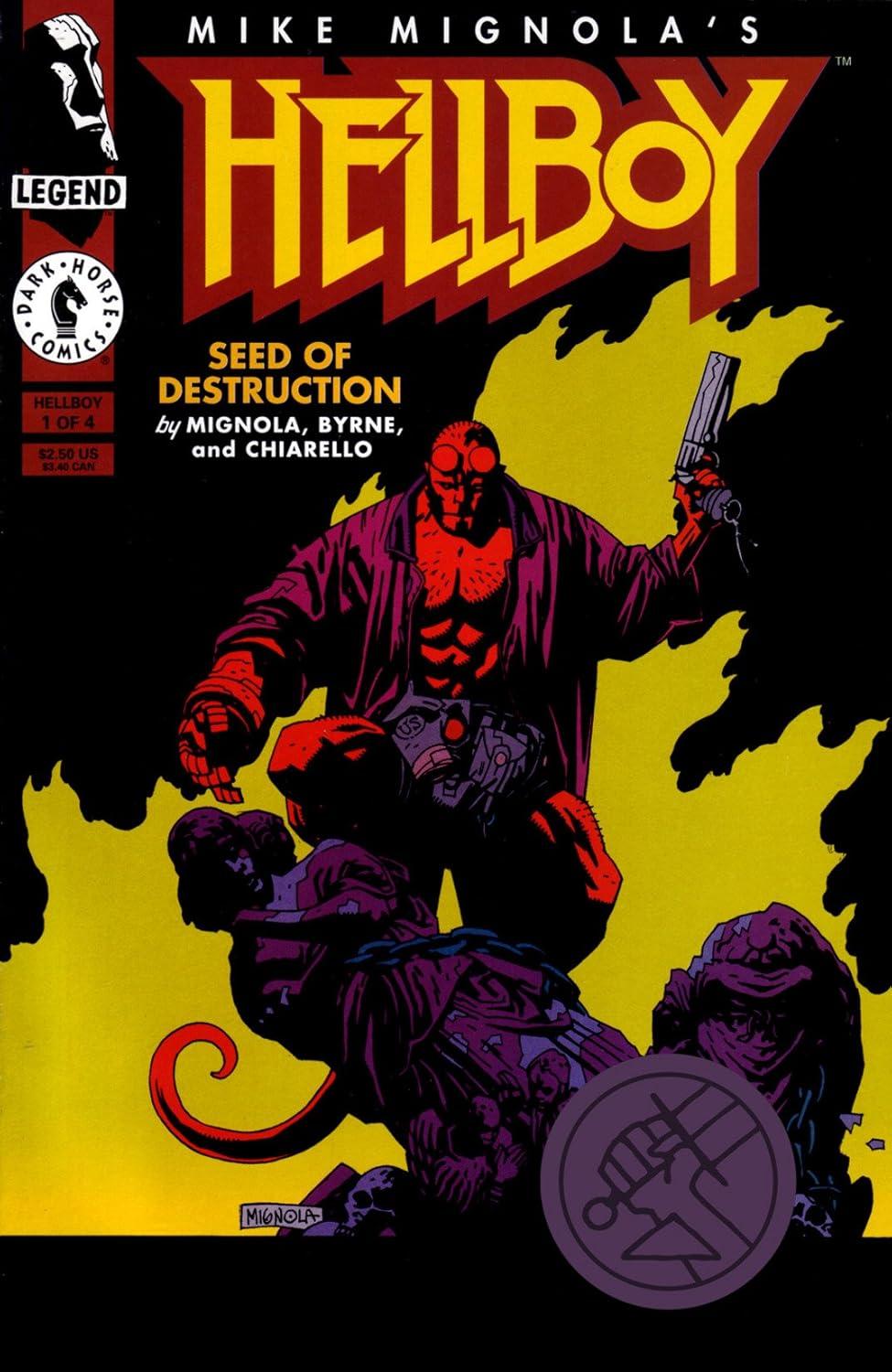
Del Toro, Mignola and production designer Stephen Scott did a lot of drawing during the movie’s preproduction process, and these sketches were eventually turned into storyboards and then animatics under the supervision of visual-effects producer/supervisor Edward Irastorza and Tippett effects supervisor Blair Clark. During that stage, the filmmakers began to make decisions about how complex effects shots would be broken down. Says Navarro, “Depending on what the action of the characters is, one thing can go in different directions. It can be a stunt action scene, or it can be a completely CGI scene, and the needs are entirely different if you’re just doing background plates or if you’re dealing with the actual characters and rigging. There are sequences that are all about the effect, and there are many effects that are just contributing to the reality.”
The process continued, scene by scene, when the production moved to Prague, Czech Republic, where filming took place from February to August 2003. There, Navarro was joined by gaffer Alex Skvorzov, key grip Rick Stribling, and first AC Timothy Kane, along with other crew members he’d worked with in Spain on The Devil's Backbone: camera assistant Juan Leyva, camera operator Joaquin Manchado and dolly grip Carlos Miguel. Czech crewmembers included rigging gaffer Dean Brkic and Steadicam operator Jaromir Sedina, who, “on the first day, when we were in snowy mountains, managed to start moving like we were on solid dollies,” recalls Navarro.
Allowing for Hellboy’s effects requirements, its camera style is as mobile as possible. “There are very rarely locked-off shots,” says Navarro, who employed Moviecam Compacts on the shoot, as well as an Arriflex 435 for some variable-speed shots. “The Moviecam has the quality of being very light, very silent and very steady, so we were able to pull off the shots.” Much of the film comprises either Steadicam work or moving shots that dolly grip Miguel captured with a unique, pivoting crane-and-track system that allows for “very sophisticated and precise moves that completely beat what a traditional dolly can do,” according to Navarro. In most shots, multiple cameras were running, one of them often operated by Navarro.
The cinematographer used a wide range of Zeiss Ultra Prime and Variable Prime lenses: “The widest we used was probably a 14mm, and we used the 400mm quite a bit.” Most of the film was shot on Kodak Vision2 500T 5218. “When you need to be working on the edge, it performs very well,” Navarro testifies. “The latitude is incredible. For me, it was a blessing to have this stock available, because our lighting scheme was very complicated.”
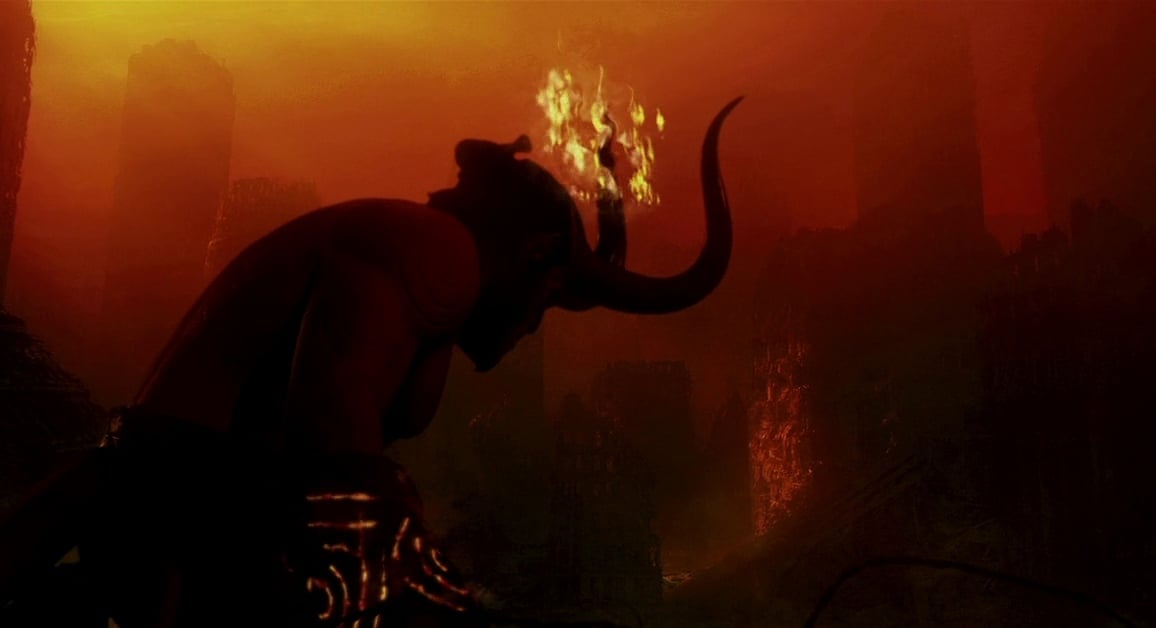
One element complicating the lighting was the fact that Hellboy was shot in a number of big sets built not on soundstages, but on location, in old warehouses or factories — none of which had pre-existing grids, of course. A case in point is the set for the opening World War II-era sequence, which establishes the film’s darkly stylized tone. In this prologue, we witness the Rasputin character, in world-dominating league with the Nazis, open the portal to hell and summon the title character. The setting is the ruins of a Gothic abbey, which was built from scratch inside a quarry. “We were trying to call up images that relate to the archive of images in your brain of World War II, with the Nazi paraphernalia and the uniforms and the black leather, along with some other ingredients that you may recognize, like traditional blue moonlight,” explains Navarro. To supply this moonlight, Maxi-Brutes filtered with steel-blue gel were set up on the ridge above the quarry. “Fortunately, the ridge came around the set, so I was able to do backlight sources,” the cinematographer adds.

“Depending on where I was shooting from, I was able to turn on some banks and turn off others, which allowed me to work pretty quickly.”
Inside the set, center stage was occupied by a spinning, gyroscopestyle machine. The base and center pole were built practically, but the rest of the device was later added digitally by visual-effects artists at The Orphanage. “We initially assumed a real gyroscope would be spinning there, and that the digital effects would begin when it starts to emit energy,” says Irastorza. “But then they decided to make it fully digital, so we went from a sequence that had approximately 45 or 50 [effects] shots to one that had almost 100 shots.” On set, Navarro added interactive light with Lightning Strikes units and flame sources, and used a Maxi-Brute to represent light emanating from the machine. “It’s very strong and eventually sort of takes over the set,” the cinematographer says of this source. “I brought it up to gradually increase its power. I used dimmers a lot — we needed them to control color temperature and intensity because we weren’t on a stage and couldn’t make changes manually very easily.”

Navarro says this sequence, which was shot about midway through Hellboy's production, was “probably the most difficult thing I’ve had to shoot in my life.” For one thing, it was very cold — “a good 16 nights of below-zero weather.” Then there was the artificial rain that often saturated the set and froze overnight, icing the trees and the terrain. “Once we got through that,” says Navarro, “everything was doable.”
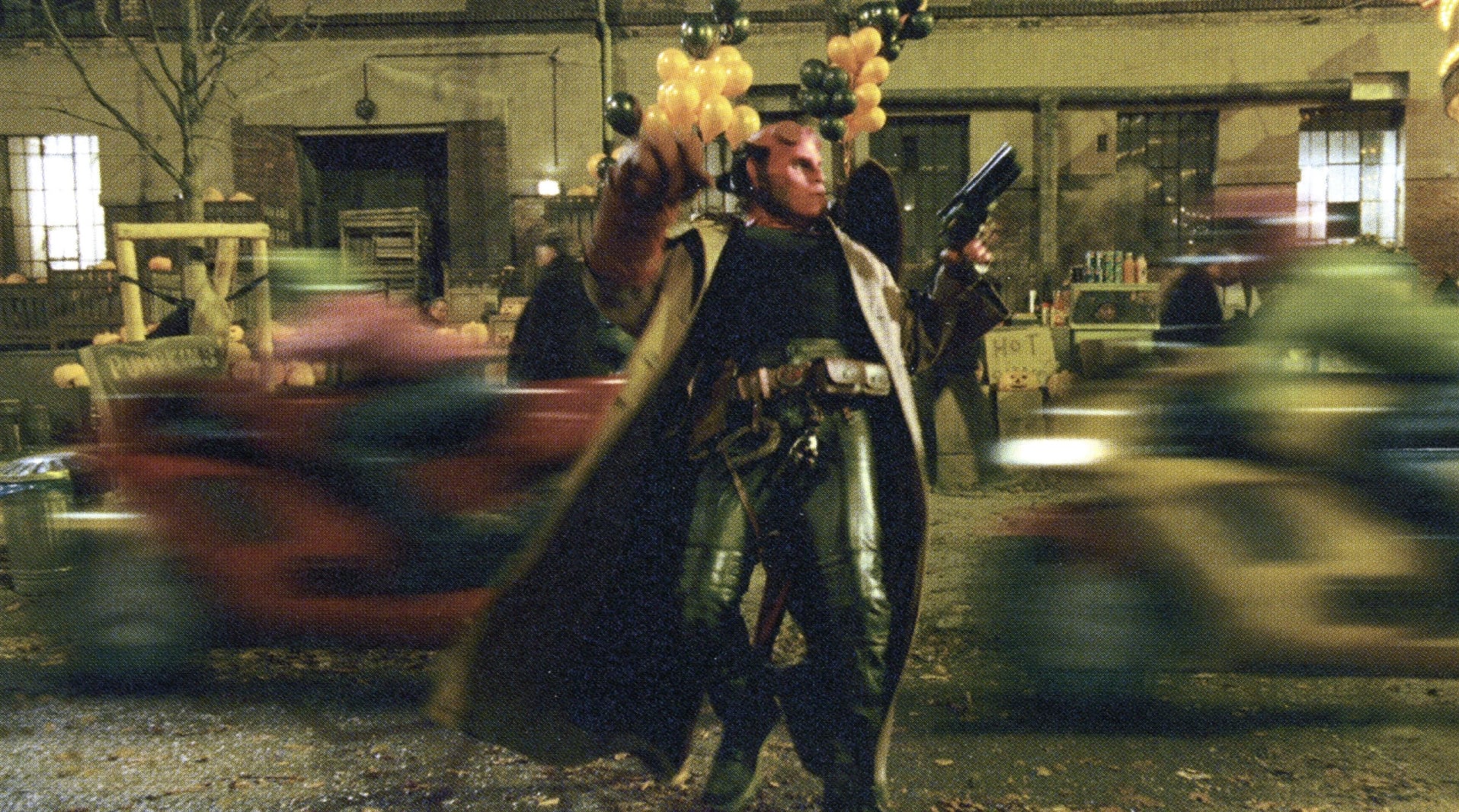
“Everything” included all of the film’s more or less present-day scenes, which are primarily set in a comic-book version of New York and New Jersey created in the Czech Republic. Whereas the prologue was designed with a bold period aesthetic, the rest of the movie has more of an urban aesthetic. Says Navarro of the contemporary scenes, “All of our night exteriors were lit in a very urban, sodium-vapor light, and we used a deep amber gel, Lee 104. I try to do all that work with the lights as opposed to in camera; in camera, I like to be very, very clean.”
The amber gel also provided the perfect complement to Hellboy’s skin tone. Perlman’s translucent red makeup, created by Rick Baker, was such an on-camera success that the character only had to replaced by a digital stunt double in a few action shots. “We did some lighting tests the first time Ron was in makeup, and we took advantage of his facial structure,” says Navarro. “We were very pleased with how light coming from above would sculpt his face; many times he’s lit with top back- or top sidelight, so that the upper part of his eyes would shade down. His eyes are invisible many times; they look like black squares. They only appear once in a while, and when they do, they’re these incredible yellow-orange eyes. When they show up, they just kill you.”

Even though Hellboy is largely a live-action character, there were enough digital creatures in the film to keep the Tippett Studio, which was in charge of character animation, busy for months. The fish-like Abe Sapien, for example, is a made-up Doug Jones on dry land, but a digital character in his aquarium home in Dr. Broom’s office. “We built that tank and it was full of water, and we shot it knowing we were going to put the CG character in there,” says Clark, who also worked on Blade II’s effects. “It was a very clean body of water, but as we started working on the shots, Guillermo requested that we put a little bit of stuff into it so you could identify it as being a volume of water. We started amping up some of the reflections on the glass, adding some bubbles and particulate matter in the background.”
Clark says the effects team followed the visual parameters established by Navarro and his crew. “There’s a huge responsibility due to the time and effort put into photographing plates, and I want the camera crews and everybody that’s involved to be happy with our work,” the effects supervisor says. “We need to survey the set, and we need to go out and hold the gray ball for shadow density and lighting direction, and the chrome ball for light positions. To an uninitiated crew, we look like we’re insane. But Guillermo Navarro is very knowledgeable, and he has an established team that’s like a well-oiled machine. That was amazing to watch — and the hardest thing to mess with.”
Still, some concessions had to be made to the effects crew. In the scene that shows Sapien in his tank, for example, “I asked them to turn out the lights on the tank interior so we could shoot another pass and get information for the reflections on the glass from the room behind us,” says Clark. “I also asked them to insert a specially made ground glass into the camera for visual-effects shots. It had the 1:85 markings shifted over to the center of full aperture, so if we needed to do a camera shake or something like that, we had an even amount of room on all sides of the image. When we re-output the film, we moved the image back over to the correct position.”
In another sequence, Sapien is shown swimming through a murky, barnacle-encrusted environment. A swimming figure is a digital headache, says Clark. “You always run into problems with the shoulders; as soon as you raise the arm above the character’s head, the computer has a hard time dealing with the stretching in the armpit and what to do with the deltoid.” Animation supervisor Todd Labonte helped solve those issues with animatics, but still to be addressed was the matter of selling the live-action background plate, which was shot dry for wet, with water added digitally. Navarro came to the rescue with interactive lighting effects created with the aid of large, shallow pans of water that were gently rippled to create wave effects on the walls. “We determined where the angle of water was going to be reflecting and aimed beams of light from Source Fours into the water to create those ripples,” says the cinematographer, who adds that he frequently uses the ETC ellipsoidal units to take advantage of their internal lens. “It’s very important to create a directional effect, and a sense of how the light would behave if there were moving water there.”

Another of Tippett Studio’s major responsibilities involved the character of Sammael, a monster Clark describes as “a cross between a gorilla and a lion, with a rhinoceros hide that’s got all these intricate occult patterns, and hair that’s a mass of tentacles.” One of Sammael’s talents is the ability to execute 180- degree turns at the waist. “That was a bit of a challenge,” says Clark. “In the real world, for example, if you turn a sock 180 degrees, you’re going to get an hourglass-shape, a pinched portion in the middle. How do you maintain the volume and still make the movement look creepy and visceral? We had to write a muscle and skin-solving tool in-house to come up with a solution.” Navarro says, “Sammael was often 100-percent digital; at other times, he was played by a stuntman in a suit who was quite close to the camera.” In the latter case, “there were puppeteers with radios manipulating the character’s eyes, face and jaws, and all of the saliva he produces.”
The costumed Sammael served as the effects artists’ match reference, according to Clark. “If there are any shots of him in the same sequence, we generally refer to him for lighting reference — how the light falls on him, where the shadows are.” The most difficult scene for the visual-effects supervisor features Hellboy and multiple Sammaels fighting in a grotto in knee-deep water. “It’s got one of my favorite shots so far, a long shot of Hellboy fighting six of these things,” Clark enthuses. “They’re jumping on him, and he flips them and starts punching them. We kind of mixed it up in that sequence: we’ll have a shot where all the characters are CG, and then in the next shot, we’ll try to get a couple of guys in Sammael suits in the foreground and choreograph around that. In the subsequent shot, we’ll have Ron or a stunt guy punching.”
Navarro notes that although several of his previous projects featured creatures that were brought to life both practically and digitally, the complexity of the task on Hellboy made it unique. “There are quite a lot of characters like that, and they are presented in many different scenarios,” he says. “I feel our use of puppets augmented by CGI on this picture is very successful.”
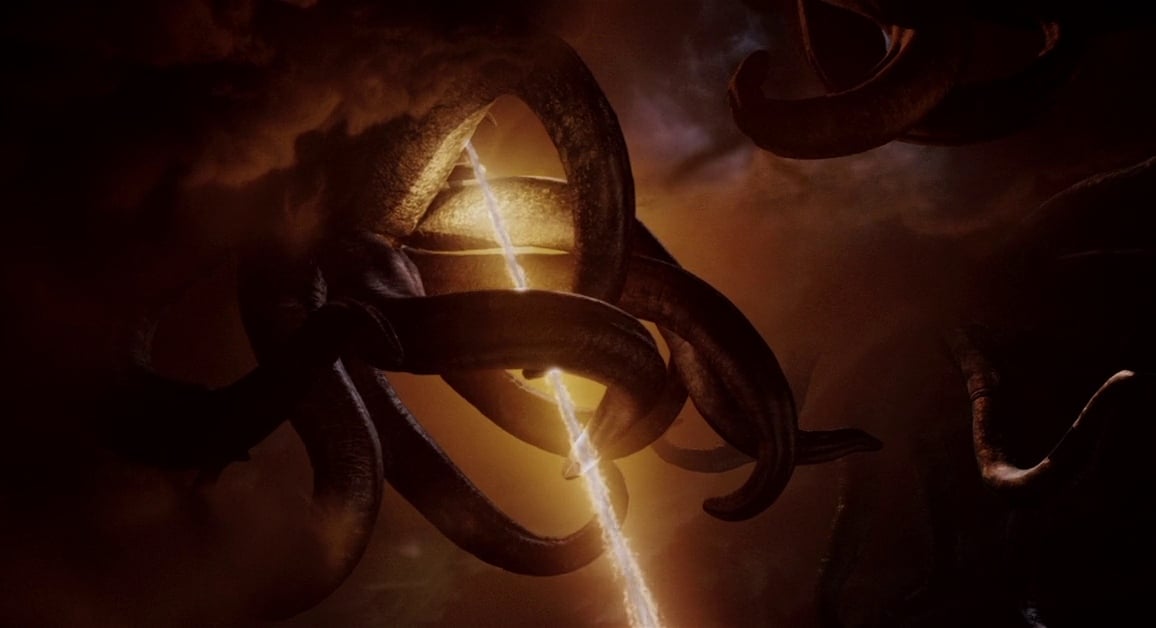
Of the 130 shots Tippett Studio is contributing to Hellboy, only a few are all-CG shots. In the film’s climax, when Hellboy fights a giant, tentacled behemoth inside a catacomb set, several shots have no live-action elements. “Guillermo wanted some camera moves following Hellboy as he’s being lifted up by the tentacle, and they’re going at speeds and heights and covering so much ground that they just couldn’t get a camera to do that,” says Clark. “The all-CG-set is a straight match to the live set, which is difficult. If you’re off on one thing, then you’ve failed.”
Tippett artists shared responsibility with Orphanage artists on another Sammael-Hellboy encounter, shot as a Prague exterior but set on New York’s busy West Side Highway. The Tippett team created the running creatures, while The Orphanage team created digital cars.
Another big sequence for The Orphanage places Hellboy and other characters on a high, treacherous bridge. “We built a bridge that collapsed into four pieces, and there was a lot of stunt and wire work up there with real actors,” says Irastorza. “We shot it against a gigantic greenscreen in an abandoned hockey arena and then composited it into a digital environment.” This environment resembles giant clockworks, “with lots of wheels and cogs and pulleys and things moving of finto inky blackness. To make it come fully to life, a full matte painting was used to integrate the real plate into the background.”
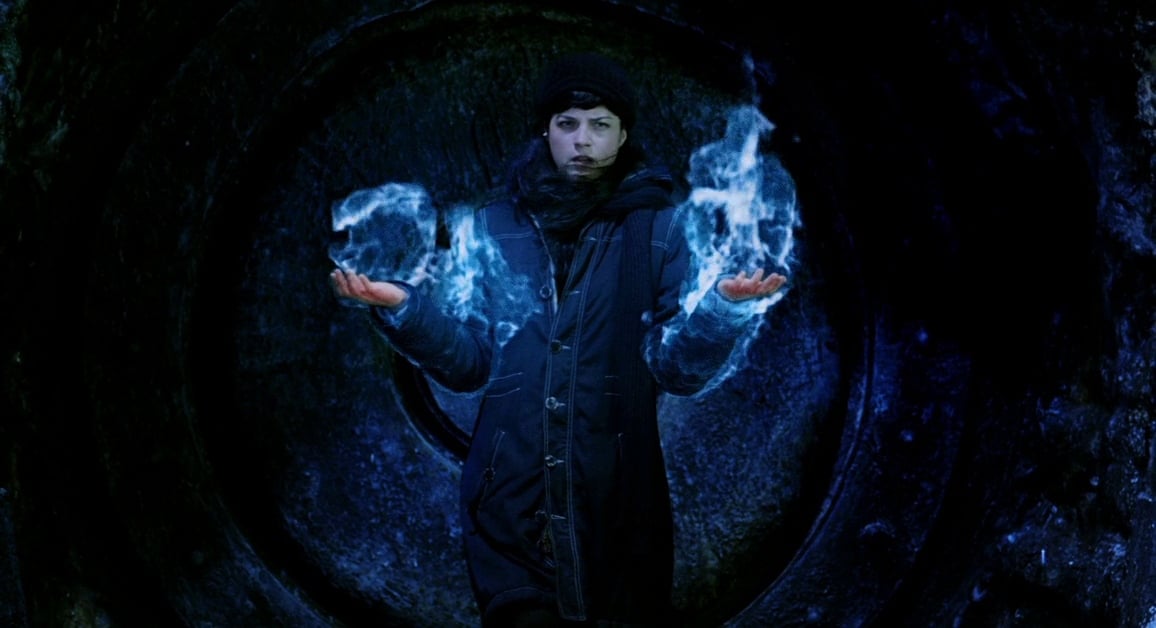
Other effects companies working on the film include Café Effects, which is contributing some of Liz Sherman’s fiery exertions; Himani, which is adding trains and other effects to a subway sequence; Eden Effects, which is doing character enhancements to the live-action Sapien; and Fantasy II, whose tasks included matched exploding miniatures to a Prague apartment complex and a hospital set.
One thing that distinguishes Hellboy from many other effects-heavy films is that there was no second unit. “Del Toro doesn’t believe in them — he wants to do every single shot,” says Navarro. “We shot all of the inserts for the greenscreen, all of the action, everything. Each time we were in a set for more than 10 days, we would always have a greenscreen set up somewhere. I would have a camera, and one of the operators would be a visual-effects guy shooting elements. We built a large greenscreen cove, ground and wall in one set, and shot a lot of material with the cameras on cranes shooting into the green. Many times there were greenscreens incorporated into sets, and they would just build from what we had. For instance, there’s a very beautiful, Arctic-blue ice cavern where a group of characters are walking; we shot the characters against greenscreen, and the rest is a phenomenal matte painting. What we tried to do each time was ground the effect with the reality of the image and the interactivity of the light, or share some of the elements that were in the frame — dust, rain or whatever. You have to bring the visual effect into the reality of your shot.”
After handing off so many of his shots for others to complete, Navarro regained some control over the images by taking Hellboy through a full-length digital intermediate (DI), a first for the cinematographer. At press time, he had begun the work at EFilm, where he was collaborating with colorist Mike Eaves. “When they farm [work] out to visual-effects companies, everything comes back in a very different range of printing lights, and the shots always come in at the last minute, after you’ve already made a pass on your timing,” observes the cinematographer. “The DI offers much better control in terms of unifying the film’s look. Also, we’re really going in and accentuating the look of certain scenes, taking them a bit closer to what we had in mind at the beginning. When we leave EFilm each day, we feel as though the comic book is coming to life more and more.”
Tech Specs
- 1.85:1
- Moviecam Compact; Arri 435
- Zeiss lenses
- Kodak Vision2 500T 5218, Vision 250D 5246
- Digital Intermediate by EFilm