The Wolves Always Come At Night: Capturing a Family, and Their Animals, In Crisis
How cinematographer Michael Latham approached the poignant documentary about Mongolian herders contending with climate change, which is Australia's entry for the Best International Feature Oscar.
Within hours of receiving permission to proceed with production of her second documentary feature, The Wolves Always Come At Night, filmmaker Gabrielle Brady contacted cinematographer Michael Latham, who had photographed her 2018 film The Island of the Hungry Ghosts, about human and crab migration on Christmas Island.
Like Ghosts, Brady conceived her new film as a poetic study of a society rattled by nature in turmoil. Wolves focused on Davaasuren Dagvasuren (Daava) and Otgonzaya Dashzeveg (Zaya), a Mongolian couple who uproot from herding horses and goats in the climate-ravaged Mongolian desert to seek new life in the city.
Brady met her subjects via a local journalist, executive producer Dorjpagma Sugar (Dopa), who had been seeking families housed in 'Ger Districts' — Mongolian for traditional canvas 'yurt' structures — outlying the capital of Ulaanbaatar. The couple was struggling with their cultural transition. "When I met Daava and Zaya," says Brady, "it was the first time I felt this more physical story of Daava haunted by his horse that he'd been forced to sell. They were looking for somebody to tell their story. But they had one rule: We needed to start shooting the next day, because that's when they were bringing everything to the city. We woke up early, picked up Michael from the airport. Luckily, his camera was charged, and we came straight back and started shooting our first scenes of their arrival in the city."
Latham had prepped, based on Brady's brief, by gathering portable lighting fixtures to assist his camera kit for the unforgiving arid environment of the Gobi desert. Working as a one-man unit, Latham used his personal Arri Alexa Mini LF, a DJI Ronin 2 gimbal, and custom power supplies. "The LF is quite power hungry," notes Latham. "But I've customized my battery solution to run off DJI TB50 Ronin/drone batteries, which charge incredibly fast. Using those, I'm able to run a generator for a short period of time and charge batteries within an hour and a half, rather than four hours. That did mean carrying a lot of batteries with us. We had 12."


Latham and Brady framed desert landscapes in the 2.35:1 aspect ratio and used Richard Gale Optics Clavius prime lenses, with rehoused vintage Russian 58mm f2 Helios optics. "The Clavius lenses have adapters in the front," Latham explains. "We had a 28, a 38, a 58, and a 88mm. I could pull those apart, and add different irises. Gab and I both love texture in the image, so because the Clavius lenses are based off of an old Russian design, they gave us great flares." For the first 10-day shooting block, the production team lived in a ger adjacent to Daava and Zaya's family, where Latham served as his own digital imaging technician. "Those were long days and, because we were shooting multiple cards, I was having to set alarms. By the time I got to bed, it was midnight, with a morning call, and the production wanted rushes, so I was transcoding at the same time. On the second block, we installed Otgon-Erdene Erdene-Ochir as our DIT with a laptop in the ger, where they could download footage."
The filmmakers carried a minimal lighting package that included an Aputure 600D LED and four Nanlite Pavo II tubes, and improvised solutions to keep pace with galloping animals and herder motorbikes. For the film's opening, tracking alongside Daava on his beloved stallion, Latham hung from the open door of a minivan. "We were guerrilla style," says Brady. "We had to work with what was there. That van had an automated door, so we had to prop it open and block the sensor so that Michael didn't get squashed."
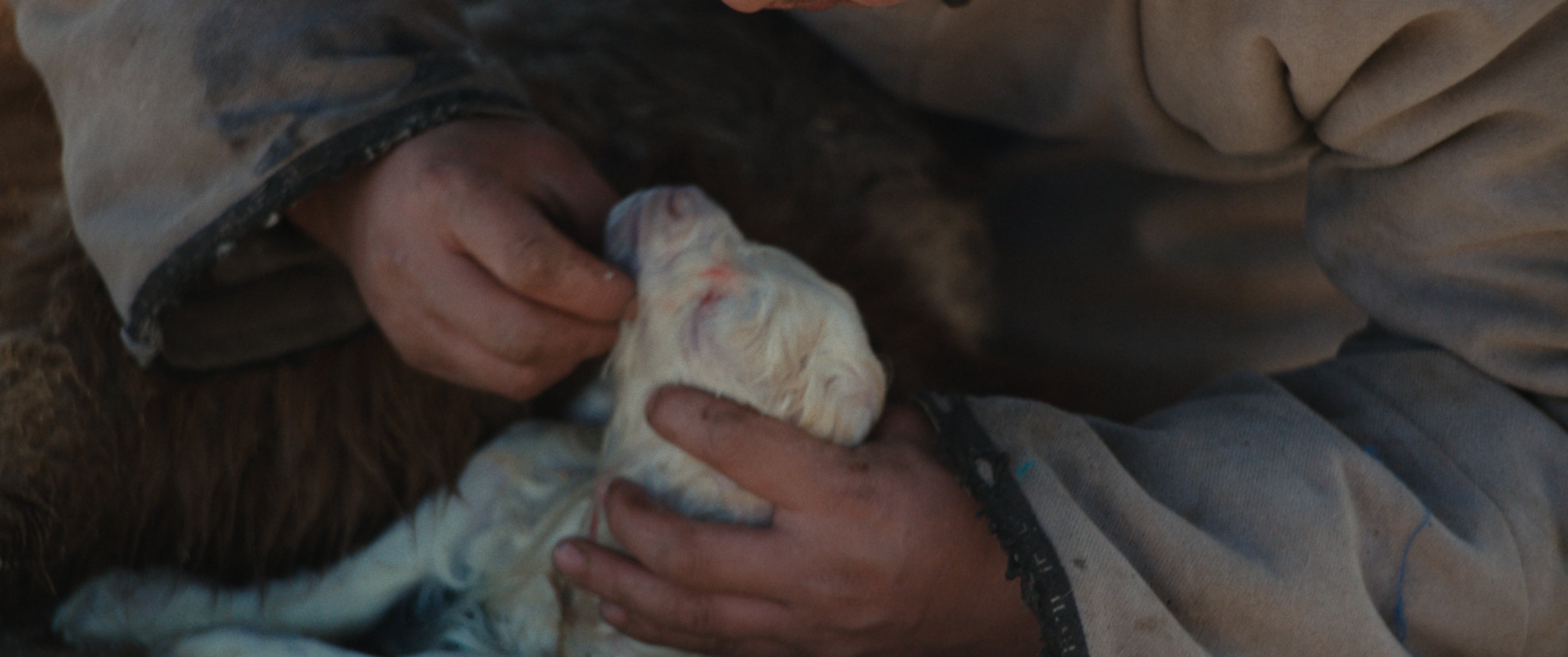

The herders' connection with their animals required sensitivity to the animals' gentle bond with their herders. Latham covered scenes of goats giving birth using the Ronin camera rig to gradually float in with the camera. "We had to approach slowly, shooting at a distance," said Latham. "Once they gauged that we were there, we came closer. The other risk was that the mother can reject its kid, if it feels that it's in danger. There had to be an initial bonding moment, where Daava introduced the mother and her kid to make sure they marked each other's scents. We had to be cautious with the way we shot those scenes so we didn't cause a separation."
A dust storm that obliterates half the goat herd was a natural occurrence that the filmmakers captured by focusing on the event's impact on characters. "One of the key words for our visual approach was 'intimacy,'" said Brady. "But at the same time, we were trying to achieve images of nature, with tracking shots exploring time — another important theme — how we stretched time, or stopped time, or created the sense of a lifetime in one shot, trying to achieve a bigger image beyond what was unfolding. But we had a tiny team." Translator Erdene Enkhjargal and sound recordist Zendemene-Erden Ichinnorov assisted battery and lens changes, while Latham had no formal camera assistant or focus puller. "It was just Michael with his Arri, often handheld, reacting to what nature gave us," adds Brady. "The storm happened in the very short time we were there, and we built an aesthetic and visual landscape around that."

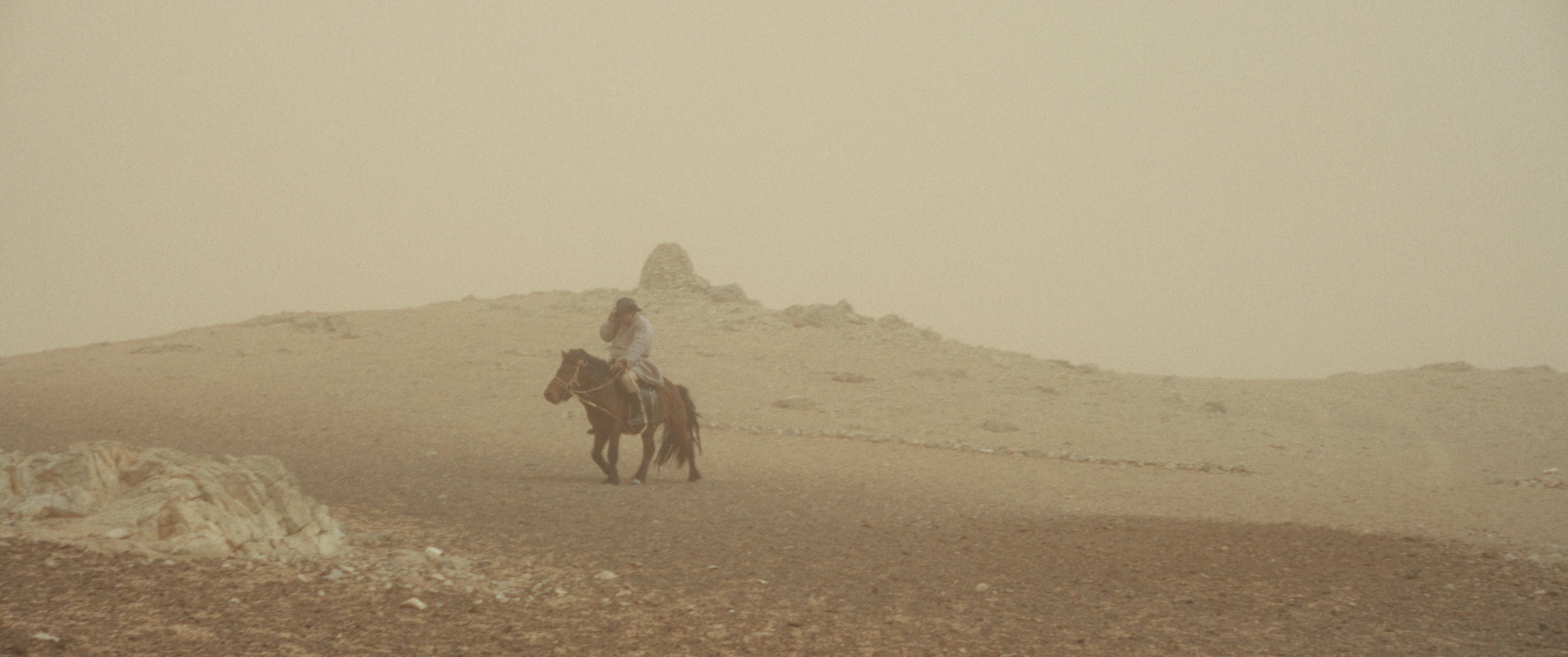
The sandstorm was a grueling assault. "It felt like people throwing fistfuls of sand in your face constantly," Latham says. "To see, I had to squint. A lot of times, I'd look down, or look away to rest my eyes because we were getting pelted. It was over quite quickly. I tried to capture as much footage while we had the opportunity. That part of the shoot had a very expensive service bill."
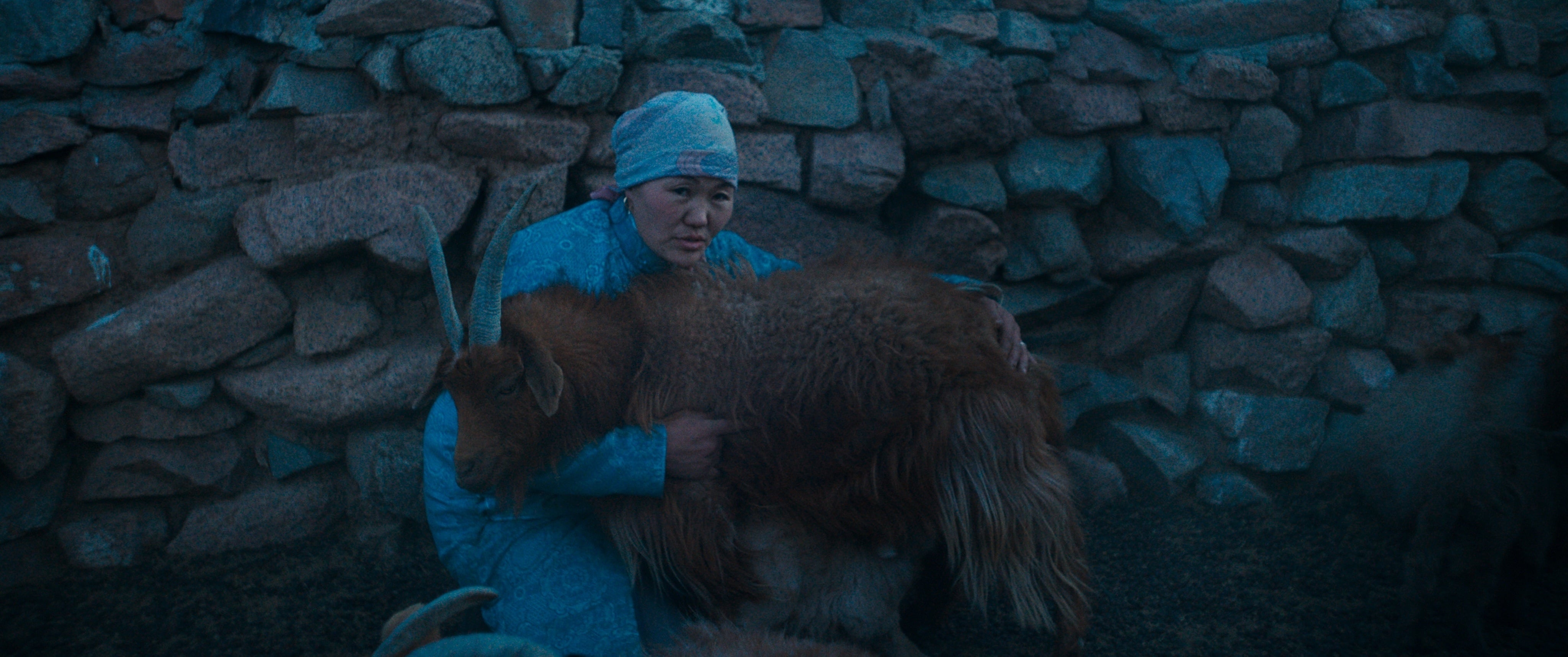
Another signature moment occurred in a peaceful respite with Zaya cradling a mother goat and kid, singing a lullaby at twilight. Brady and Latham captured the scene on the family's last night before their departure from their home, and set the look for one of several extended pans in the film. "There were a few shots that we wanted to orchestrate as bookmark or chapter shots," Latham explains. "Some didn't make it into the film; one we used at the end of the film with Daava in a bar [in the city]. We wanted those to feel like tableaus. I used the Ronin gimbal for those shots. Camera motion in the pen was difficult to keep smooth as I was pulling my own focus. But we knew they'd bring their herd in at last light, so that gave us beautiful light as we were racing against the clock."
Another lingering tableau featured the family's departure in a minivan, which featured a hypnotic 270-degree pan encompassing the van interior and terrain. "I wanted a very handheld, unfolding feeling of 'Where are things going?" says Brady. "[We were] trying to stretch time inside the image––was it minutes, days, a lifetime, or maybe even thousands of years? It represented a way of living that stretched back to the Bronze Age, and is now changing in such a short time."
Latham operated his LF on a tripod jammed into the back of the van. "We had the dynamic between the children leaving their homes," Latham adds. "There was all of their emotion, and then we drifted across, bringing the family together, showing they were on the move." The setup featured no additional lighting, relying on the latitude of the LF sensor to accommodate exposure between interior and exterior, while Latham contorted to remain out of view. "For the final reveal, as I was panning, I lost the image. I knew roughly where I wanted to end so I leaned out of the way without even seeing the shot. But that's my job, constantly being an uncomfortable position, and trying to be smooth about it."
An instinctual approach was vital to single-camera coverage, as neither Brady nor Latham spoke Mongolian. Brady's collaboration — crediting Daava and Zaya as her co-writers — involved creating settings where the couple could unburden emotions behind their gentle stoicism. "Usually they went to sleep in the ger with their children," says Brady. "One evening, I asked Dopa to take the kids outside. Our sound recordist, 1st AD and I were outside, it was only Michael inside, and that created a sense of intimacy. There was a heavy feeling that had been building inside Daava, but there was no strong sense of what they should discuss. We created a time for quiet, which they rarely have in their lives, and by creating that environment, it unfolded. We didn't know the full nuance [of their conversation] until the translations came back." Latham used his experience of reading body language to guide compositions, while a single LED tucked into the rafters bounced light into the canvas ceiling. "Greig Fraser [ASC, ACS] once said that you only need one light if it's placed in the right position," Latham adds. "Especially in documentary, that's where my mentality is. You make an educated guess and hope that it pays off."
The film reconnected the couple with their ancestral roots when Daava awakens to the discovery of wild horses in their new industrial landscape. The concept sprang from their first meeting with Brady. "Daava spoke about his connection to this horse that he'd sold," Brady recalls. "Weeks before that, I'd been doing research in the Ger Districts and I had noticed that there was a herd of horses there. Each day, they'd bring these horses across to feed on the other side of the hills. So, they were there, but only in the daytime, and only in small numbers. We asked the herders to double, or triple their number, to bring in as many horses as they had at night, because at night it created ambiguity —was this real, or a dream? I was obsessed with that 'in between' space. That was the configuration of this movement that resulted in the ending of the film."
Logistics of wrangling horses in the Ger District created some of the productions greatest challenges. "It was chaos," Latham says with a laugh. "These were wild horses. A lot of the animals retained a memory to a route, and all the horses wanted to go home. There were not many lights in the district, so we wanted to put them down a street that had lights. But there were also people trying to drive home in their cars, which made for a tricky situation. The shot of the horses coming down the hill was lit with real street lights and car headlights glaring in the background. We shot one take. I also shot handheld on the back of a motorbike, but our tracking bike guy was also busy herding horses, so I ended up in the middle of the horses because the herder needed to guide the herd. At one point, I was running with the horses."
The choreography evoked a sense of magical realism, depicting a vanishing culture in a cinematic manner that resonated with Brady's subjects during the editorial process. "The first cut that we shared with Daava and Zaya," Brady recalls, "their reaction was deep. I wasn't in the room, but the crew told me they looked at each other, and said, 'That's exactly how it was.' That was a beautiful statement. There's been a lot of discussion about the film's construction. And I understand for a particular audience it's important to know how and why we made it this way. It is a hybrid film. But for me, a film is a film. And the material is incredibly observational. Daava and Zaya found a lot of it funny, because they remembered how it was made, which was cathartic, and they had their in-jokes — they thought Daava's hair looked like a sheep. At the heart of it, this is a documentary, because it is their experience."